

Overview
The Scheduler page is the control plane for recurring prompt-driven work. It combines job configuration, summary metrics, pause and resume controls, manual run-now actions, and historical run tracking.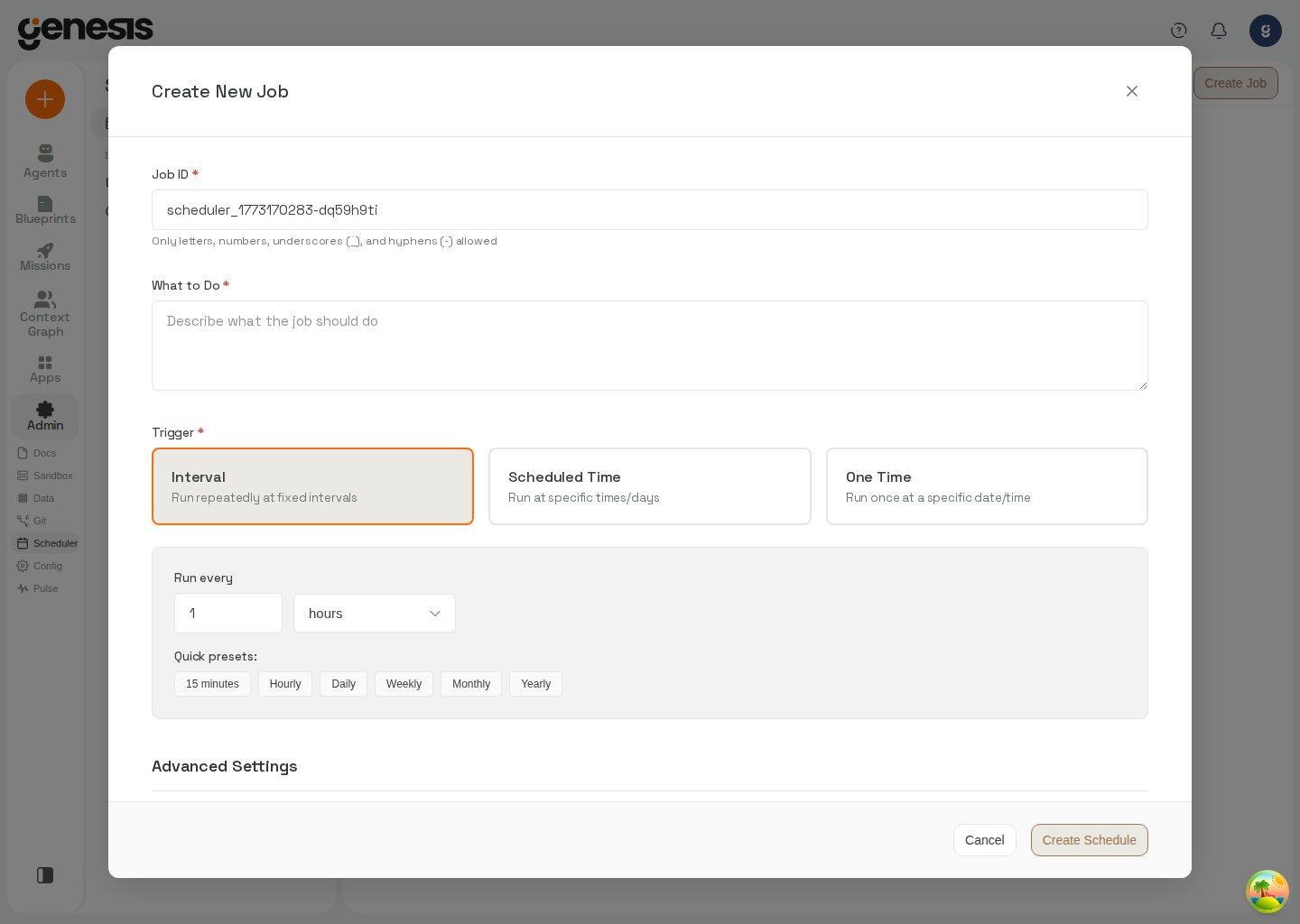
In auth-enabled deployments, Genesis shows the Scheduler workspace only when
your role has at least one of
access_config_panel, view_scheduler, or
manage_scheduler. The dedicated view_scheduler permission is enough to
open the Jobs and History tabs without broader Config access.Jobs and history
The page also surfaces summary cards such as total jobs, active runs, success rate, and failed runs.
Genesis can also display cron jobs created programmatically from partial trigger objects. When a cron trigger omits
minute, hour, day, month, or day_of_week, the Scheduler page treats the missing field as the wildcard * in its human-readable schedule summary. For example, {"type":"cron","minute":0} appears as an hourly schedule instead of requiring every cron field to be present.
Platform background jobs such as cleanup workers, metrics uploads, and the Twin
harvest master switch are managed from Pulse -> Jobs rather than this page.
Create a job
The job modal captures a job ID, the prompt to run, trigger type, agent, optional thread target, max instances, and misfire grace settings. Quick interval presets and a cron builder help users define schedules without leaving the UI.Schedule expiration
Recurring jobs expose an End date in the create and edit modal. Enter the date and time in your local timezone; Genesis stores and sends the expiration as an ISO timestamp. The Scheduler table shows the resulting Expires at time next to the trigger. A job stops recurring after its end date, although a run that is already in progress can finish. For an intentionally ongoing cron or interval job, select Run indefinitely and enter a non-empty reason describing who or what owns stopping it. This records the reason with the job and displays it in the jobs table. The two options are mutually exclusive: selecting Run indefinitely clears the end date. One-time date jobs do not show these expiration controls. Frequent schedules still follow the scheduler’s cadence limits: runs less than 5 minutes apart require an end date within 7 days, and runs at least 5 minutes but less than 1 hour apart require one within 30 days. See Expiration and intentional perpetual schedules for the complete policy and managed refresh behavior.Job names
Each prompt job has a stable job ID (set at creation) and an optional display name. The Jobs table shows the display name when it differs from the job ID; otherwise it shows the job ID. When a custom display name is set, the job ID appears as a secondary line under the name in the list and in the job modal header. Rename a job from either place:- Jobs table — click the pencil icon next to the job name in the row.
- Job modal — click the pencil icon next to the job name in the modal header.
scheduler_periodic_backup do not expose rename controls.
Daily operations
Scheduled work runs as a system scheduler user, not as the user who created
the job. If a scheduled job or flow uses a saved Connection, bind a role the
scheduler user holds to that connection’s Roles with Access first, or the
run cannot resolve the connection’s secret. See
Scheduled flows that use Connections.
flow_<flow_id> job), a terminal
failure can also surface through the in-app notification bell — see
Unattended failure notifications.
The scheduler subprocess stands down its generic job-failure alert when the
Flow runner reports that the operator is already covered for this failure
streak — either because Genesis created a notification on this run
(operator_notified) or because the runner deliberately stayed quiet because
an earlier run in the same streak already notified the operator
(operator_notification_coverage is suppressed). If the Flow never reached
the runner (for example the Flow was deleted while its schedule still exists),
or coverage is not_covered, the generic scheduler alert remains the only
signal.