> ## Documentation Index
> Fetch the complete documentation index at: https://docs.genesiscomputing.com/llms.txt
> Use this file to discover all available pages before exploring further.
# Matillion Connector
> Manage and execute Matillion Data Productivity Cloud pipelines through Genesis Data Agents.
## Overview
The Matillion connector integrates Genesis with
[Matillion Data Productivity Cloud (DPC)](https://www.matillion.com/products/data-productivity-cloud),
enabling agents to upload, execute, and monitor data pipelines from natural-language
conversations.
With this connector you can:
* **Publish transformation and orchestration pipelines** to Matillion projects (single file or multi-file bundle).
* **Execute pipelines** from the currently published bundle and monitor job status until completion.
* **Review run history** and find failed or cancelled executions across projects.
* **List published pipelines and uploaded artifacts** in a project (draft pipelines remain in git / Designer only).
* **Manage projects and environments** in your Matillion account.
* **Automate end-to-end ETL/ELT workflows** — run a pipeline, grant Snowflake permissions
on the output tables, and make the data immediately available to Genesis agents.
***
## Prerequisites
Before setting up the connector, gather the following from your Matillion account:
| Item | Where to find it |
| - | - |
| **Client ID** | Matillion DPC -> Settings -> API Access -> your API client |
| **Client Secret** | Displayed once when the API client is created — copy it immediately |
| **Region** | US (`app.matillion.com`) or EU (`eu1.app.matillion.com`) |
You need the `pipeline-execution` OAuth scope, which is requested automatically by the
connector.
***
## Setup
There are two ways to configure the Matillion connector: the **Matillion Integration**
page (quickest for a single connection) and the **Connections** page (supports multiple
named connections with RBAC).
### Option A — Matillion Integration page
1. Click **Config** in the left sidebar, then select **Matillion Integration**.
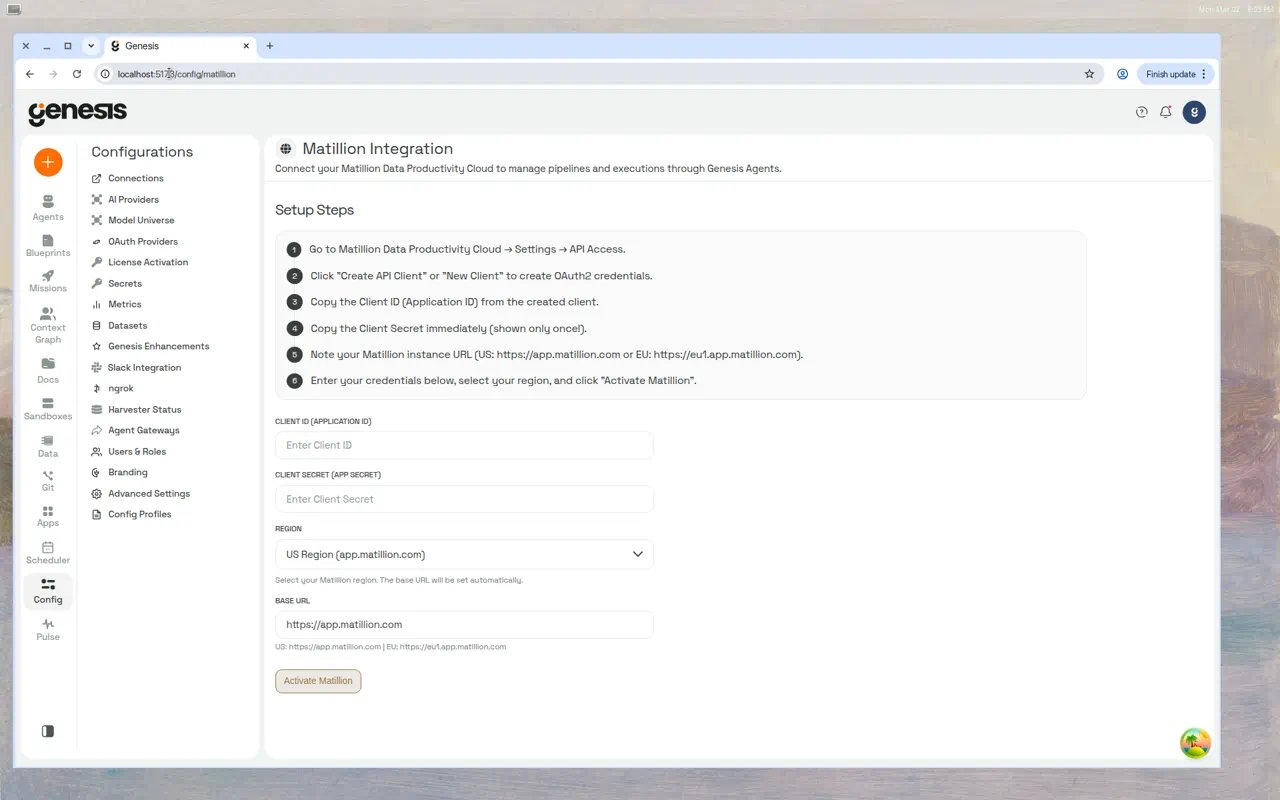 2. Follow the setup flow:
1. Go to Matillion DPC -> Settings -> API Access.
2. Click **Create API Client** or **New Client** to generate OAuth2 credentials.
3. Copy the **Client ID** (Application ID).
4. Copy the **Client Secret** immediately — it is shown only once.
5. Note your Matillion instance URL (US or EU).
6. Enter credentials below, select your region, and click **Activate Matillion**.
3. Fill in the form:
* **Client ID (Application ID)** — your Matillion API client ID.
* **Client Secret (App Secret)** — your secret. Once saved, the field displays as
masked (`••••••••`) with a configured-state indicator and a **Change** button.
* **Region** — select **US Region (app.matillion.com)** or
**EU Region (eu1.app.matillion.com)** from the dropdown. The Base URL updates
automatically.
* **Base URL** — auto-filled from your region selection.
### Option B — Connections page
The Connections page supports multiple named Matillion connections with role-based access
control. Use this when you need separate connections for different environments (for example
production vs. staging).
1. Navigate to **Config -> Connections** and filter to **Data Pipelines**.
2. Follow the setup flow:
1. Go to Matillion DPC -> Settings -> API Access.
2. Click **Create API Client** or **New Client** to generate OAuth2 credentials.
3. Copy the **Client ID** (Application ID).
4. Copy the **Client Secret** immediately — it is shown only once.
5. Note your Matillion instance URL (US or EU).
6. Enter credentials below, select your region, and click **Activate Matillion**.
3. Fill in the form:
* **Client ID (Application ID)** — your Matillion API client ID.
* **Client Secret (App Secret)** — your secret. Once saved, the field displays as
masked (`••••••••`) with a configured-state indicator and a **Change** button.
* **Region** — select **US Region (app.matillion.com)** or
**EU Region (eu1.app.matillion.com)** from the dropdown. The Base URL updates
automatically.
* **Base URL** — auto-filled from your region selection.
### Option B — Connections page
The Connections page supports multiple named Matillion connections with role-based access
control. Use this when you need separate connections for different environments (for example
production vs. staging).
1. Navigate to **Config -> Connections** and filter to **Data Pipelines**.
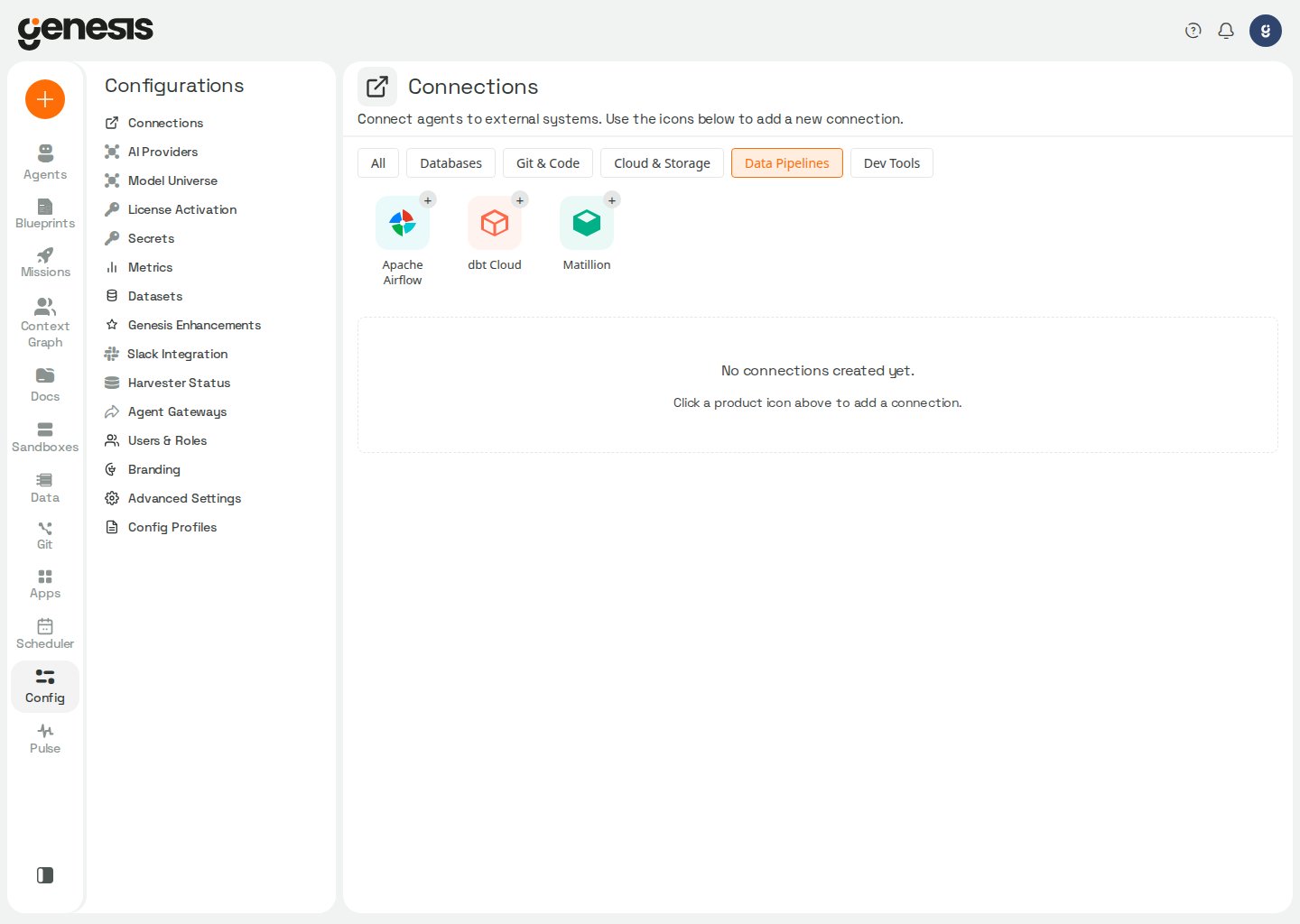 2. Click the **+** button on the **Matillion** icon.
3. Fill in the connection form:
* **Connection Name** — for example `production` or `staging`. Agents reference this as
`matillion.production`.
* **Roles with Access** — control which roles and agents can use this connection.
* **Base URL** — your Matillion instance URL.
* **Client ID** — your API client ID.
* **Client Secret** — your secret.
* **Set as default connection** — when checked, agents use this connection
automatically when no specific connection is named.
4. Click **Test Connection** to verify credentials, then **Create Connection**.
### Option C — Via agent conversation
You can also configure credentials by telling an agent:
> *"Set up my Matillion connection with client ID abc123 and secret xyz789 for the
> US region."*
The Config UI is recommended for initial setup since it validates inputs and stores
secrets securely.
### Connection selection for agents
When an agent calls `matillion_connector` without naming a `connection`, Genesis
resolves one in this order:
1. The effective default `matillion` connection for the current user (My default, then
Role default).
2. If no default is set and exactly one Matillion connection is accessible, that
connection is used automatically.
3. If multiple connections exist without a default, the agent must pass `connection`
explicitly (for example `connection="matillion.production"`).
Use `LIST_CONNECTIONS` to discover configured connections (`connection_id`, `base_url`,
`is_default`) before other actions when unsure which connection to use, or after a
connection-not-found error. See
[matillion\_tools](/docs/Genbot-Toolkit/Additional-Tool-Groups#matillion-tools) for
tool parameters and response fields.
***
## Snowflake SPCS deployments
When Genesis runs as a Snowflake Native App (SPCS), the connector needs outbound network
access to reach the Matillion API. Two additional buttons appear on the Matillion
Integration page after activation:
| Button | What it does |
| - | - |
| **Approve External Access** | Opens the Snowflake UI to approve the `matillion_external_access` External Access Integration. This allows outbound HTTPS to `id.core.matillion.com`, `us1.api.matillion.com`, and `eu1.api.matillion.com`. |
| **Assign to Genesis** | Binds the approved EAI to the Genesis application so the connector can make API calls. |
Both steps must be completed before the connector can authenticate from within SPCS.
***
## Authentication
The connector uses **OAuth2 Client Credentials** to authenticate with Matillion:
| Parameter | Value |
| - | - |
| Token endpoint | `https://id.core.matillion.com/oauth/dpc/token` |
| Grant type | `client_credentials` |
| Scope | `pipeline-execution` |
Tokens are cached and automatically refreshed before they expire. You do not need to
manage tokens manually.
### Region detection
The connector maps your Base URL to the correct regional API endpoint:
| Base URL pattern | API endpoint |
| - | - |
| `app.matillion.com` | `https://us1.api.matillion.com/dpc/v1` |
| `eu1.app.matillion.com` or `eu` in URL | `https://eu1.api.matillion.com/dpc/v1` |
***
## Run history and monitoring
Agents with `matillion_tools` can audit recent pipeline runs and inspect what is
published in a project without an `execution_id`.
### Check run history (`LIST_EXECUTIONS`)
Use `LIST_EXECUTIONS` when asked to check Matillion run history, find failed runs,
or audit errors — for example *"check Matillion for errors"* or *"any failed runs
lately?"*. No `execution_id` is required.
Optional parameters:
| Parameter | Type | Default | Description |
| - | - | - | - |
| `project_id` | string | none | Scope to one project; omit to list runs across all projects. |
| `status_filter` | string | none | Only return executions with this status (for example `FAILED` or `SUCCESS`). Matched case-insensitively. |
| `limit` | integer | `25` | Maximum number of executions to return. |
The response includes `executions` (most recent first), `count`, `status_counts`, and
`failed_count`. `failed_count` aggregates `FAILED`, `ERROR`, and `CANCELLED` statuses;
`failed_count == 0` means no errors were found in the returned window. Each execution
row includes fields such as `pipelineName`, `status`, `startedAt`, `finishedAt`,
`trigger`, `user`, `projectId`, and `environmentName`. Drill into one run with
`GET_JOB_STATUS` using `project_id` and `execution_id` from the row.
Example prompts:
> *"Check the Matillion run history for errors in the last day."*
> *"List failed Matillion pipeline runs for project abc-123."*
### List pipelines in a project (`LIST_PIPELINES`)
Use `LIST_PIPELINES` with `project_id` to inspect what is **published (runnable)**
and what appears in **artifact upload history**. Optional `environment_name` defaults
to `default`. Set `runnable_only=true` when you only need the answer to *"what can I
run right now?"* — upload history is omitted.
The response separates views:
| Field | Meaning |
| - | - |
| `published_pipelines` | Pipelines in the currently published bundle — these are runnable via `RUN_PIPELINE`. |
| `artifact_history` | Prior uploads. Each publish **replaces** the environment bundle, so history rows are not necessarily runnable. |
| `pipelines` | Legacy combined list (published + artifact rows). |
Each row is tagged with `source` set to `published` or `artifact`.
Draft pipelines are **not** exposed by the Matillion public API. They live in the
project's git repository and appear only in the Designer UI. An empty `LIST_PIPELINES`
result means nothing is published or uploaded — not that the project has no pipelines.
Example prompts:
> *"What Matillion pipelines are published in project abc-123?"*
> *"What can I run in Matillion project abc-123 right now?"* (agent uses `runnable_only=true`)
For tool parameters and response fields, see
[matillion\_tools](/docs/Genbot-Toolkit/Additional-Tool-Groups#matillion-tools).
***
## Publishing pipelines (`UPLOAD_ARTIFACT`)
Each `UPLOAD_ARTIFACT` call **replaces the environment's entire published bundle**.
Any pipeline not included in the call becomes unrunnable via the API until you
re-publish it together with the rest of the bundle.
A single-file publish can silently evict other pipelines that were previously
published. Always check `evicted_pipelines` in the response, or call
`LIST_PIPELINES` with `runnable_only=true` before and after publishing.
### Publish modes
Provide `project_id` plus **one** of these input patterns:
| Mode | Parameters | When to use |
| - | - | - |
| **Bundle (recommended)** | `yaml_repo_id` + `yaml_file_paths` | Publish multiple pipelines atomically from a Genesis git repo. Paths can include globs, for example `['silver/*.yaml', 'silver_v2/*.yaml']`. Each file publishes at its repo path. |
| **Single file from git** | `yaml_repo_id` + `yaml_file_path` + `artifact_path` | Publish one YAML file read from a repo at an explicit bundle path. |
| **Single file direct** | `yaml_content` + `artifact_path` | Publish inline YAML without reading from git. |
Optional parameters: `version_name` (auto-generated when omitted), `branch_name`
(recommended for Designer visibility), `environment_name` (default `default`).
On success the response includes `published_files` and, when applicable,
`evicted_pipelines` — a non-empty list is a warning that previously runnable
pipelines were dropped from the bundle.
Upload failures return the upstream HTTP `status_code`, `error`, and `details`.
Transient 5xx responses are retried automatically before an error is returned.
Example prompts:
> *"Publish all silver pipelines from the pharma\_matillion repo to Matillion project abc-123."*
> *"Upload gold/summary.tran.yaml to Matillion and tell me if anything was evicted."*
***
## Running pipelines (`RUN_PIPELINE`)
`RUN_PIPELINE` resolves pipelines from the **currently published bundle**, not from
the project's git link. A pipeline merged in git is not runnable via the API until
its bundle is published with `UPLOAD_ARTIFACT`.
If execution fails with a 404 or "pipeline not found":
1. Call `LIST_PIPELINES` with `runnable_only=true` (or check rows where `source` is
`published`) to confirm the pipeline is in the published bundle.
2. A prior single-file publish may have evicted it — re-publish all required
pipelines together with `yaml_file_paths`.
3. If the pipeline is published, check `branch_name_run` (selects among published
branches only), `environment_name`, and agent permissions.
Use `branch_name_run` only when you need a specific published branch; leave it unset
for the default published bundle.
***
## Pipeline types
Matillion pipelines are YAML files that define data processing workflows. There are two
types, each with different syntax and capabilities.
### Transformation pipelines (`.tran.yaml`)
Transformation pipelines perform data ETL operations inside Snowflake. They use a
component graph where data flows from sources through transformations to targets via
the `sources` keyword.
**Common components:**
| Component | Purpose |
| - | - |
| `table-input` | Read from a Snowflake table. Specify `database`, `schema`, `targetTable`, and `columnNames`. |
| `aggregate` | Group and summarize: `Sum`, `Count`, `Count Distinct`, `Avg`, `Min`, `Max`. |
| `filter` | Filter rows based on conditions. |
| `join` | Combine data from multiple sources (`Inner`, `Left`, `Right`, `Full`). |
| `calculator` | Add computed columns with SQL expressions. |
| `rewrite-table` | Write results to a target Snowflake table. |
### Orchestration pipelines (`.orch.yaml`)
Orchestration pipelines control workflow logic. They chain steps together using
**transitions** and can execute SQL statements or call transformation pipelines.
**Common components:**
| Component | Purpose |
| - | - |
| `start` | Entry point. Uses `transitions.unconditional` to link to the next step. |
| `sql-executor` | Execute SQL (DDL, DML, GRANT). Requires `scriptLocation: "Component"` plus `sqlScript`. |
| `run-transformation` | Execute a transformation pipeline by path (`transformationJob`). |
Orchestration pipelines use `transitions` for flow control — not `sources`.
2. Click the **+** button on the **Matillion** icon.
3. Fill in the connection form:
* **Connection Name** — for example `production` or `staging`. Agents reference this as
`matillion.production`.
* **Roles with Access** — control which roles and agents can use this connection.
* **Base URL** — your Matillion instance URL.
* **Client ID** — your API client ID.
* **Client Secret** — your secret.
* **Set as default connection** — when checked, agents use this connection
automatically when no specific connection is named.
4. Click **Test Connection** to verify credentials, then **Create Connection**.
### Option C — Via agent conversation
You can also configure credentials by telling an agent:
> *"Set up my Matillion connection with client ID abc123 and secret xyz789 for the
> US region."*
The Config UI is recommended for initial setup since it validates inputs and stores
secrets securely.
### Connection selection for agents
When an agent calls `matillion_connector` without naming a `connection`, Genesis
resolves one in this order:
1. The effective default `matillion` connection for the current user (My default, then
Role default).
2. If no default is set and exactly one Matillion connection is accessible, that
connection is used automatically.
3. If multiple connections exist without a default, the agent must pass `connection`
explicitly (for example `connection="matillion.production"`).
Use `LIST_CONNECTIONS` to discover configured connections (`connection_id`, `base_url`,
`is_default`) before other actions when unsure which connection to use, or after a
connection-not-found error. See
[matillion\_tools](/docs/Genbot-Toolkit/Additional-Tool-Groups#matillion-tools) for
tool parameters and response fields.
***
## Snowflake SPCS deployments
When Genesis runs as a Snowflake Native App (SPCS), the connector needs outbound network
access to reach the Matillion API. Two additional buttons appear on the Matillion
Integration page after activation:
| Button | What it does |
| - | - |
| **Approve External Access** | Opens the Snowflake UI to approve the `matillion_external_access` External Access Integration. This allows outbound HTTPS to `id.core.matillion.com`, `us1.api.matillion.com`, and `eu1.api.matillion.com`. |
| **Assign to Genesis** | Binds the approved EAI to the Genesis application so the connector can make API calls. |
Both steps must be completed before the connector can authenticate from within SPCS.
***
## Authentication
The connector uses **OAuth2 Client Credentials** to authenticate with Matillion:
| Parameter | Value |
| - | - |
| Token endpoint | `https://id.core.matillion.com/oauth/dpc/token` |
| Grant type | `client_credentials` |
| Scope | `pipeline-execution` |
Tokens are cached and automatically refreshed before they expire. You do not need to
manage tokens manually.
### Region detection
The connector maps your Base URL to the correct regional API endpoint:
| Base URL pattern | API endpoint |
| - | - |
| `app.matillion.com` | `https://us1.api.matillion.com/dpc/v1` |
| `eu1.app.matillion.com` or `eu` in URL | `https://eu1.api.matillion.com/dpc/v1` |
***
## Run history and monitoring
Agents with `matillion_tools` can audit recent pipeline runs and inspect what is
published in a project without an `execution_id`.
### Check run history (`LIST_EXECUTIONS`)
Use `LIST_EXECUTIONS` when asked to check Matillion run history, find failed runs,
or audit errors — for example *"check Matillion for errors"* or *"any failed runs
lately?"*. No `execution_id` is required.
Optional parameters:
| Parameter | Type | Default | Description |
| - | - | - | - |
| `project_id` | string | none | Scope to one project; omit to list runs across all projects. |
| `status_filter` | string | none | Only return executions with this status (for example `FAILED` or `SUCCESS`). Matched case-insensitively. |
| `limit` | integer | `25` | Maximum number of executions to return. |
The response includes `executions` (most recent first), `count`, `status_counts`, and
`failed_count`. `failed_count` aggregates `FAILED`, `ERROR`, and `CANCELLED` statuses;
`failed_count == 0` means no errors were found in the returned window. Each execution
row includes fields such as `pipelineName`, `status`, `startedAt`, `finishedAt`,
`trigger`, `user`, `projectId`, and `environmentName`. Drill into one run with
`GET_JOB_STATUS` using `project_id` and `execution_id` from the row.
Example prompts:
> *"Check the Matillion run history for errors in the last day."*
> *"List failed Matillion pipeline runs for project abc-123."*
### List pipelines in a project (`LIST_PIPELINES`)
Use `LIST_PIPELINES` with `project_id` to inspect what is **published (runnable)**
and what appears in **artifact upload history**. Optional `environment_name` defaults
to `default`. Set `runnable_only=true` when you only need the answer to *"what can I
run right now?"* — upload history is omitted.
The response separates views:
| Field | Meaning |
| - | - |
| `published_pipelines` | Pipelines in the currently published bundle — these are runnable via `RUN_PIPELINE`. |
| `artifact_history` | Prior uploads. Each publish **replaces** the environment bundle, so history rows are not necessarily runnable. |
| `pipelines` | Legacy combined list (published + artifact rows). |
Each row is tagged with `source` set to `published` or `artifact`.
Draft pipelines are **not** exposed by the Matillion public API. They live in the
project's git repository and appear only in the Designer UI. An empty `LIST_PIPELINES`
result means nothing is published or uploaded — not that the project has no pipelines.
Example prompts:
> *"What Matillion pipelines are published in project abc-123?"*
> *"What can I run in Matillion project abc-123 right now?"* (agent uses `runnable_only=true`)
For tool parameters and response fields, see
[matillion\_tools](/docs/Genbot-Toolkit/Additional-Tool-Groups#matillion-tools).
***
## Publishing pipelines (`UPLOAD_ARTIFACT`)
Each `UPLOAD_ARTIFACT` call **replaces the environment's entire published bundle**.
Any pipeline not included in the call becomes unrunnable via the API until you
re-publish it together with the rest of the bundle.
A single-file publish can silently evict other pipelines that were previously
published. Always check `evicted_pipelines` in the response, or call
`LIST_PIPELINES` with `runnable_only=true` before and after publishing.
### Publish modes
Provide `project_id` plus **one** of these input patterns:
| Mode | Parameters | When to use |
| - | - | - |
| **Bundle (recommended)** | `yaml_repo_id` + `yaml_file_paths` | Publish multiple pipelines atomically from a Genesis git repo. Paths can include globs, for example `['silver/*.yaml', 'silver_v2/*.yaml']`. Each file publishes at its repo path. |
| **Single file from git** | `yaml_repo_id` + `yaml_file_path` + `artifact_path` | Publish one YAML file read from a repo at an explicit bundle path. |
| **Single file direct** | `yaml_content` + `artifact_path` | Publish inline YAML without reading from git. |
Optional parameters: `version_name` (auto-generated when omitted), `branch_name`
(recommended for Designer visibility), `environment_name` (default `default`).
On success the response includes `published_files` and, when applicable,
`evicted_pipelines` — a non-empty list is a warning that previously runnable
pipelines were dropped from the bundle.
Upload failures return the upstream HTTP `status_code`, `error`, and `details`.
Transient 5xx responses are retried automatically before an error is returned.
Example prompts:
> *"Publish all silver pipelines from the pharma\_matillion repo to Matillion project abc-123."*
> *"Upload gold/summary.tran.yaml to Matillion and tell me if anything was evicted."*
***
## Running pipelines (`RUN_PIPELINE`)
`RUN_PIPELINE` resolves pipelines from the **currently published bundle**, not from
the project's git link. A pipeline merged in git is not runnable via the API until
its bundle is published with `UPLOAD_ARTIFACT`.
If execution fails with a 404 or "pipeline not found":
1. Call `LIST_PIPELINES` with `runnable_only=true` (or check rows where `source` is
`published`) to confirm the pipeline is in the published bundle.
2. A prior single-file publish may have evicted it — re-publish all required
pipelines together with `yaml_file_paths`.
3. If the pipeline is published, check `branch_name_run` (selects among published
branches only), `environment_name`, and agent permissions.
Use `branch_name_run` only when you need a specific published branch; leave it unset
for the default published bundle.
***
## Pipeline types
Matillion pipelines are YAML files that define data processing workflows. There are two
types, each with different syntax and capabilities.
### Transformation pipelines (`.tran.yaml`)
Transformation pipelines perform data ETL operations inside Snowflake. They use a
component graph where data flows from sources through transformations to targets via
the `sources` keyword.
**Common components:**
| Component | Purpose |
| - | - |
| `table-input` | Read from a Snowflake table. Specify `database`, `schema`, `targetTable`, and `columnNames`. |
| `aggregate` | Group and summarize: `Sum`, `Count`, `Count Distinct`, `Avg`, `Min`, `Max`. |
| `filter` | Filter rows based on conditions. |
| `join` | Combine data from multiple sources (`Inner`, `Left`, `Right`, `Full`). |
| `calculator` | Add computed columns with SQL expressions. |
| `rewrite-table` | Write results to a target Snowflake table. |
### Orchestration pipelines (`.orch.yaml`)
Orchestration pipelines control workflow logic. They chain steps together using
**transitions** and can execute SQL statements or call transformation pipelines.
**Common components:**
| Component | Purpose |
| - | - |
| `start` | Entry point. Uses `transitions.unconditional` to link to the next step. |
| `sql-executor` | Execute SQL (DDL, DML, GRANT). Requires `scriptLocation: "Component"` plus `sqlScript`. |
| `run-transformation` | Execute a transformation pipeline by path (`transformationJob`). |
Orchestration pipelines use `transitions` for flow control — not `sources`.