> ## Documentation Index
> Fetch the complete documentation index at: https://docs.genesiscomputing.com/llms.txt
> Use this file to discover all available pages before exploring further.
# Connections
> Create and manage external system connections used by Genesis Data Agents, apps, datasets, and supported integrations.
## Overview
The **Connections** page is the central place to add and manage external systems in Genesis. Connections power data access, source control, document systems, cloud services, and integration workflows used across apps, missions, datasets, and agent conversations.
## Main connection workflow
1. Open **Config -> Connections**.
2. Click **+ New Connection** in the page header (including the first-run empty state when you have no connections yet).
3. In the **New connection** modal, optionally filter by category or search, then select the provider you want.
4. Enter credentials or complete the relevant OAuth flow.
5. Choose **Connection scope** and default options (see [Personal vs shared connections](#personal-vs-shared-connections) and [Default connection layers](#default-connection-layers)).
6. Test the connection (for **User OAuth**, testing happens after you authorize — see below).
7. Save it for reuse.
The Google Chat **Connect** link on **Config → Request sources** opens a new
Google Workspace connection and requests `service_account` auth and `shared`
scope. The form selects that auth method when available and ignores the request
if it is marked unavailable. The effective scope still follows the current
user's permissions: users without `manage_all_connections` create personal
connections.
If the system is inside a private network that Genesis cannot reach (for example, Genesis
runs in Snowflake and the database is on-prem), answer **How does Genesis reach this
system?** with **Through a Genesis Outpost**. See [Genesis Outposts](/docs/Setup/Outposts-Overview).
When you edit a saved connection and change its connection details, Genesis tests
the new details before saving them. The update is refused if the target system
cannot be reached, and the existing connection and stored credentials remain in
place. If you choose **Use existing** for a credential conflict, Genesis tests the
credential that is already stored rather than the value entered in the form.
If a save needs to create or replace more than one stored credential and one write
fails, Genesis attempts to undo the other writes from that save so the connection
is not partially updated. Earlier replaced credentials are restored and newly
created credentials are deleted when possible. If another request changed a
credential after this save wrote it, Genesis leaves that newer value in place and
reports that the undo was incomplete; the connection is not saved.
When **Test Connection** fails, Genesis uses the HTTP status held by the
connection tester when one is available. A held `401` means the presented
credential was rejected, so Genesis appends when the connection's stored
credential was last written, when that timestamp is available. If the response
says that the credential is missing or unconfigured, Genesis does not treat the
`401` as a rejection of a stored credential. A held `403`
means access was refused without treating the stored credential as invalid, so
Genesis does not date it. Other held statuses are not interpreted as `401` or
`403` based on text from the response, although credential-specific wording can
still identify cases such as a revoked OAuth grant. If no status was returned,
Genesis falls back to the error text.
External secret references such as `outpost_/#`,
`aws_*`, `gcp_*`, and AWS ARNs are pointers, not credential values stored in
Genesis. Genesis reads those values from the external store and normally caches
them for up to `GENESIS_EXTERNAL_SECRET_CACHE_TTL_SECONDS` seconds (default
`300`; set it to `0` to disable caching). If a connection test rejects a value
after its store has rotated, Genesis drops that reference from this process's
cache, so retrying reads the current value immediately; other workers can keep
their own cached value until its TTL expires. If the retry is also rejected,
correct the value in the external store. There is no credential value to
re-enter in Genesis.
If the write time cannot be read, the result says so instead. If you rotated the
credential after the reported time, apply the current value to the saved
connection and retry; rotating it only in the issuing system does not update
Genesis's stored copy. Connections that authenticate with an ambient identity
or an inline locator value show that no stored credential is available to
rotate.
### Guided post-save setup
After you save a connection, Genesis can open a setup guide near the top of the
page and scroll you to it automatically so the remaining steps stay in view.
The guide turns post-save work into explicit steps such as:
* confirming the save,
* running egress preflight and approving external access in Snowflake / SPCS when the connector type requires it,
* completing the provider OAuth grant when required,
* testing the saved connection.
For **User OAuth** connections, the post-save guide numbers its steps based on
what still applies: when egress preflight is required, it is step 1, **Connect
OAuth** is step 2, and **Test Connection** is step 3; when egress preflight does
not apply, **Connect OAuth** is step 1 and **Test Connection** is step 2. On
Snowflake Native App / SPCS deployments, the egress preflight step appears only
for connector types that declare external-access integration requirements in the
connection registry (not for every OAuth connection).
In Genesis Desktop, **Connect OAuth** opens the provider sign-in in the system
browser instead of an in-app popup. Keep the Connections page open; it updates
when the sign-in finishes.
For GitHub and GitLab's OAuth app setup step, see
[OAuth Providers](/docs/Setup/OAuth-Providers).
In Genesis Desktop, a saved Snowflake connection may also offer its account's
Snowflake Cortex on **Config → AI Providers** and after browser sign-in. Choose
whether Cortex should serve chat only or chat and embeddings; nothing switches
until you choose. If the connection needs Snowflake OAuth, Genesis opens a
browser sign-in before applying the choice. The same offer is available from the
Cortex provider form; see [Snowflake Cortex setup](/docs/Setup/Setup-AI-Model#provider-specific-notes).
The Genesis redirect URI embeds the saved **connection name**, so each OAuth
connection needs its own callback URL registered in the provider. When you create
a connection, Genesis suggests a default name (for example `salesforce_oauth_main`)
and selects the full suggestion when you focus the name field so typing replaces
it rather than appending — appending would change the callback URL and can cause
`redirect_uri_mismatch` at grant time.
On the **Connect OAuth** step — and in the OAuth recovery guide opened from
`?open_oauth=.` — Genesis shows the exact callback URL again with
**Copy redirect URI**, plus provider-specific guidance on where to register it
when the authorization popup reports `redirect_uri_mismatch`. Genesis omits the
URL when it cannot derive a character-exact value (for example when the Genesis
base URL is not configured).
In Snowflake Native App / SPCS deployments, user-created **Snowflake**
connections egress through their configured public or PrivateLink account host
and show the usual **Approve External Access** and **Assign to Genesis**
steps in the post-save guide — for every saved auth type (**Programmatic Access
Token**, **User OAuth**, **Key Pair**, and username/password).
The step state updates in place as external access and OAuth status change, and
you can close the guide once the connection is ready. When OAuth authorization
succeeds but Genesis detects a configuration issue that may block the next tool
call (for example an Atlassian site URL mismatch on Confluence User OAuth),
Genesis still marks the grant complete and surfaces an English diagnostic
warning on the OAuth card, in a warning toast on the Connections page, or in
the post-save guide — follow that message before testing or using the
connection in chat.
For user-triggered external-access actions, Genesis performs a live assignment
recheck instead of waiting for the passive status cache to expire. In practice,
the guide should advance within a few seconds after you approve access in
Snowflake / SPCS or click `Assign to Genesis`.
After `Assign to Genesis`, Genesis verifies the binding on the live
`GENESISAPP_SERVICE_SERVICE` service rather than trusting
`CORE.UPGRADE_SERVICES()` alone. If the UI reports that the reference was
recorded but is not attached to the running service, the Snowflake upgrade step
returned success without applying the binding (for example when the service had
no prior external-access list). Retry assignment or inspect
`GENESISAPP_SERVICE_SERVICE` in Snowsight before continuing.
Each external access integration is tracked independently by its Snowflake
reference name (for example `genesis_external_access` for general outbound
access and `tailscale_external_access` for embedded Tailscale). Assigning or
approving one integration does not remove bindings for other references, even
when they share the same integration type in Snowflake.
If you click `Check Again` before the approval is visible, the guide tells you
to confirm the Snowflake approval and retry. If the approval is visible but the
connection is still not ready, Genesis surfaces the first reported preflight
failure reason so you can see which endpoint or readiness check is still
blocked.
### Launchpad handoff
If you start a connector from **Launchpad**, Genesis opens the new-connection modal with the selected connector type already set. Closing that modal returns you to Launchpad and restores the in-progress journey so you can continue the guided setup.
The Launchpad **Setup checklist** and the connect banners on **Data Explorer**
and **Git Browser** open **Config → Connections** with `?from=launchpad` so
closing the connection modal returns you to Launchpad the same way. Checklist
**Set up →** links use that return leg without pre-selecting a connector type;
journey connector pickers can still deep-link with `new_type` and `open_new=true`.
Guided journeys such as **Plan a data migration** and **Onboard client files**
map your answers into structured blueprint inputs (and `journey_context` when the
recipe uses it) when Genesis starts the recommended mission. Connection pickers
show saved connections with connector branding; when no match exists, Genesis
offers a link to add one and resume the journey.
Migration pipeline discovery uses Context Graph lineage for the selected source
database. Chat migration can also start from a pipeline-service connection; see
[Migrate data and pipelines](/docs/User-Guide/Chat-And-Threads#migrate-data-and-pipelines)
for how those sources route to their service tools or loaded warehouse. Saving a
database connection alone does not register it as a lineage source; add it in
[Digital Twin and Context Graph](/docs/User-Guide/Digital-Twin-And-Context-Graph#configure-lineage-sources-and-scans)
when you want the migration planner to discover its producers. The planner can
still propose a data-only plan when lineage is unavailable.
From the migration destination card, **Clone** opens the new-connection form
prefilled with the source connection's non-secret fields and additional hosts.
It keeps the source authentication mode when that mode is available and
preserves its route when it uses an outpost. Credentials are never copied; enter
them again in the new connection form before saving.
### Connection mode chooser
When a connector supports more than one authentication type, Genesis shows a
**Connection mode** chooser before the rest of the form. Genesis pre-selects
the first available mode when the modal opens (including **User OAuth** when it
is listed first). Switch modes at any time before entering credentials, testing
the connection, or saving it.
Single-mode connectors still open directly to their fields.
When Genesis runs as a Databricks App, modes that require the host's own cloud
identity remain visible but disabled, with a reason and an alternative. This
applies to BigQuery **Application Default Credentials (Runtime Identity)**,
AWS and MWAA **IAM Role (IRSA / Pod Identity)**, MWAA **Snowflake Workload
Identity (keyless)**, and Snowflake **Restricted Caller's Rights**. The App
cannot use those identities because it does not run on Google Cloud, in an EKS
pod, or in Snowflake Container Services, and it has no Snowflake metadata
connector for workload identity. Use the corresponding service-account key,
access-key or bootstrap-key **Assume Role**, or Snowflake key-pair/OAuth mode
instead, as shown on the disabled mode's message.
In a Databricks App, AWS and MWAA **Assume Role** also requires bootstrap AWS
credentials: if `access_key_id` is omitted, Genesis marks the mode unavailable
because the STS call would otherwise use the App host's credential chain. Add
both `access_key_id` and `secret_access_key` to use this mode. These restrictions
apply to saving or testing a connection and to using a previously saved one.
The App's connection chooser also disables local Iceberg mode; see
[Databricks authentication modes](/docs/Integrations/Data%20Sources/Databricks/Databricks#choose-an-authentication-mode).
See [Connect to Databricks — Choose an authentication mode](/docs/Integrations/Data%20Sources/Databricks/Databricks#choose-an-authentication-mode)
for Databricks authentication modes, including the signed-in-user SQL mode
available inside a Databricks App and the App's restriction on PAT-backed
connections. See the [connection API reference](/docs/Genesis-API/API-Reference#connection-registry-and-pat-capability-behavior)
for update validation details.
For **User OAuth**, the create/edit modal does not show a **Test Connection**
button — Genesis shows a hint that the connection can be tested after the OAuth
login process completes. Save the connection, complete **Authorize** in the
post-save guide, then use **Test Connection** there (or on the saved row after
OAuth is connected).
When you re-test a saved **Databricks Service Principal (OAuth M2M)** connection,
the edit form may leave `client_secret` empty because the stored value is masked.
Testing the named saved connection fills that secret from the stored connection;
you do not need to paste it again. The host, `http_path`, and `client_id` still
must be present because Genesis does not fill those locator fields during the test.
`foundry_prove_app` uses this connection mode when reading a Workshop app deployed
as a Databricks App; see [the proof guide](/docs/Integrations/Palantir-Foundry/Palantir-Foundry#migrating-and-proving-a-workshop-app)
for the app access requirement.
Connection credentials are not revealed when a saved connection is read back.
Secret locator fields are returned as redacted placeholders, and credentials
embedded in connection strings or other locator text are masked while the
non-secret connection details remain visible. Secret references remain visible
as names. To replace a credential, enter its new value in the edit form; to test
the saved credential without re-entering it, use **Test Connection** on the
saved connection. The [Connections API](/docs/Genesis-API/API-Reference#connection-registry-and-pat-capability-behavior)
documents the corresponding response behavior.
### Palantir Foundry connections
The **Palantir Foundry** connector is available under **Data Pipelines**. It
currently supports **Personal Access Token** authentication. Enter the Foundry
tenant root without a trailing path and a token created in Foundry under
**Account Settings → Tokens**:
| Field | Required | Secret | Description |
| - | - | - | - |
| `base_url` | Yes | No | Foundry tenant URL, for example `https://acme.usw-17.palantirfoundry.com`. |
| `token` | Yes | Yes | Personal Access Token used to read the tenant as that Foundry user. |
For complete migration plans, ensure this token can list tenant ontologies and
read each listed ontology. See the
[Palantir Foundry migration tools guide](/docs/Genbot-Toolkit/Palantir-Foundry-Migration-Tools)
for how missing access appears in the plan.
When `base_url` is a valid HTTPS tenant URL, the token field shows **Open
Tokens in your Foundry tenant**, which opens that tenant's token settings page.
The **OAuth2 Client Credentials** mode is visible in the connection chooser but
is disabled with **Coming soon — contact Genesis to enable**. The server also
rejects create and test requests that name `auth_type: "oauth2"`; the disabled
card is discoverability, not the enforcement boundary.
For the **Test Connection** result and what its SQL-route status means, see
[Foundry connection test guidance](/docs/Integrations/Palantir-Foundry/Palantir-Foundry#test-the-foundry-connection).
For usage guidance, see the [Palantir Foundry integration guide](/docs/Integrations/Palantir-Foundry/Palantir-Foundry).
### Databricks Prover storage
Databricks connection modes expose the optional non-secret
`prover_managed_location_root` field. Set it to a connection-owned storage root
when Genesis should create throwaway Prover catalogs beneath that location.
Leave it blank when the connection does not provide managed storage. Prover
profiles may still supply an explicit `managed_location` override for a
mission; Genesis does not auto-discover arbitrary external locations.
| Field | Type | Default | Purpose |
| - | - | - | - |
| `prover_managed_location_root` | string | empty | Connection-owned storage root used by guarded Prover runs when a profile does not provide `managed_location`. |
In RBAC-enabled deployments, PAT-class saved modes (`pat`, `api_token`, and
`api_key`) are available only to roles with the matching
`access_pat_connections_` permission for that connector's
category: `databases`, `git`, `cloud`, `pipelines`, or `tools`. When a role
lacks the permission for a category, the Connections UI hides those auth
modes for connectors in that category and blocks PAT-based create, update,
and test calls for them. OAuth-based modes continue to work when the
connector supports them, while token-only connectors in that category remain
unavailable until an admin enables the matching permission.
### AWS connection modes
AWS connections support these saved modes:
| Mode label | Stored `auth_type` | Fields |
| - | - | - |
| **Access Key** | `access_key` | `access_key_id` (string, required), `secret_access_key` (string, required), `region` (string, optional), `ssh_key_name` (string, optional), `ssh_private_key` (string, optional) |
| **Assume Role** | `assume_role` | `role_arn` (string, required), `role_session_name` (string, required), `default_region` (string, required), `access_key_id` (string, optional), `secret_access_key` (string, optional), `session_token` (string, optional), `ssh_key_name` (string, optional), `ssh_private_key` (string, optional) |
| **IAM Role (IRSA / Pod Identity)** | `irsa` | `region` (string, optional) |
Genesis tests all AWS modes with an STS `get_caller_identity` lookup. If
`region` (for `access_key` or `irsa`) or `default_region` (for `assume_role`)
is blank, Genesis falls back to `us-east-1` during test and runtime operations.
Choose **Assume Role** when Genesis should call AWS APIs through a target IAM
role rather than the pod's own identity. On EKS with IRSA or Pod Identity,
leave **Bootstrap Access Key ID** and **Bootstrap Secret Access Key** blank —
Genesis uses the pod credential chain to call `sts:AssumeRole`. Provide both
bootstrap key fields only when you need a static IAM user or access key to
bootstrap the assume-role call (for example outside Kubernetes or in a
cross-account pattern that cannot use the pod role directly). Set
**Role Session Name** to a value that includes your Genesis instance name (for
example `genesis-`) so CloudTrail can identify which deployment used
the role. When bootstrap keys are omitted, **Role Session Name** is required;
when bootstrap keys are supplied, Genesis defaults the session name to
`genesis-assume-role` if the field is left blank.
Grant the bootstrap identity (the pod IAM role on EKS, or the saved bootstrap
keys elsewhere) `sts:AssumeRole` on the target role, and add a trust policy on
the target role that allows that bootstrap principal. If the trust policy or
permission is missing, **Test Connection** and runtime calls return an access
denied error that names the target role ARN and asks you to verify both sides of
the trust chain. A successful **Test Connection** for **Assume Role** also
shows the **Assumed role ARN** returned by STS (for example
`arn:aws:sts::123456789012:assumed-role/my-target-role/genesis-prod`).
Choose **IAM Role (IRSA / Pod Identity)** when Genesis should use the pod's
attached workload identity directly — no cross-account or downstream role
chain. Genesis uses the pod or host credential chain instead of saved keys.
When you create or edit an AWS connection with **IAM Role (IRSA / Pod
Identity)**, Genesis resolves the pod's IAM identity in the background and
shows an **IAM Role Identity** panel with the full caller ARN (for example
`arn:aws:iam::123456789012:role/genesis-bedrock-role`). Grant that IAM role
access to the S3 buckets, Secrets Manager secrets, and other AWS resources the
connection needs. **Test Connection** uses the same STS lookup and refreshes
the displayed ARN when the test succeeds.
When `databricks_action` runs `stage_from_s3` and you omit `params.aws_credential_name` / `params.aws_connection`, Genesis resolves the caller's scoped default **AWS** connection (**My default**, then **Role default**). If that default resolves but its secrets fail to load, Genesis returns an error instead of silently using ambient host credentials. When no scoped AWS default applies, Genesis may fall back to ambient `boto3` credentials and logs a warning — set a user or role default, or pass an explicit AWS connection name, for predictable S3 access.
## What customers should know
### Connection categories
Customers will typically see connectors grouped into categories such as:
* databases,
* Git and code,
* cloud and storage,
* data pipelines,
* `Dev Tools` such as Jira, ServiceNow, Salesforce, HubSpot, Linear, Cursor, Confluence, Jenkins, JAMS, and SAP S/4HANA.
* BI platforms such as **Microsoft Power BI** (registry category `bi`; saved rows appear under **All** until the Connections UI adds a dedicated BI tab).
On the main **Connections** page, category tabs above the saved-connections
list (**All**, **Databases**, **Git and code**, **Cloud and storage**, **Data
Pipelines**, and **Dev Tools**) filter only those rows. Genesis defaults to
**All** when the URL has no `category` parameter or the value is not one of
`all`, `databases`, `git`, `cloud`, `pipelines`, or `tools`. Selecting a tab
updates the URL (for example `?category=pipelines`); Genesis does not restore
a previously selected category from browser storage.
In the **New connection** modal, connector tiles use the same category labels
as separate pills. Those pills filter only the provider catalog inside the
modal and do not change the main-page category tabs.
**Databases** also includes providers and saved connections whose registry
marks them as data sources, even when their home category is different. For
example, Palantir Foundry remains under **Data Pipelines** and also appears
under **Databases** because it is a place data lives.
Deep links and guided flows can pass `category` in the query string to open
the page with that saved-connection filter active. Connections whose provider
type is not in the registry (legacy rows) appear only when
that filter is **All**, because their category is unknown.
### Finding connectors and saved connections
The **Connections** page centers on your saved connections. Use the category
tabs, page-header search, **Group by provider**, and **+ New Connection** to
find rows and add new ones:
* **Category tabs** above the saved-connections list narrow rows by provider
registry category. The default selection is **All**. Choosing another tab
sets `category` in the page URL (valid values: `all`, `databases`, `git`,
`cloud`, `pipelines`, `tools`). When a list criterion is active, Genesis
sends the search, category, owner, scope, auth, sort, and direction criteria
to the server and applies the response after visibility checks. The page
updates immediately with local matches while the request is in flight, then
replaces them with the authoritative server result.
* **Search providers and connections** in the page header filters the
saved-connections list. The placeholder reads `Search providers and
connections...`. Genesis matches the connection **name**, **type**, and the
provider **display label**, so typing `snow` can surface Snowflake connections
even when the connection name does not include "snow". Search is debounced by
250 milliseconds before the server request is sent.
* **Filters and sorting** are available from the sliders button beside the
page-header search. Filter saved connections by **Connection owner**,
**Scope** (`Shared`, `Personal`, or `Unknown`), and **Effective auth type**.
The owner picker includes **System**, **Legacy**, and **Unknown** buckets when
applicable; system-owned rows include rows created by
`system_default_user`. Sort the filtered rows by **Name**, **Connection owner**,
**Provider / type**, **Scope**, or **Updated time**, in **Ascending** or
**Descending** order. Search, category, filter, and sort selections are kept
in the page URL, so a filtered view can be shared or revisited with browser
navigation.
* **Results status** shows **Updating results…** while an active criterion is
being sent to the server. The list exposes the server-reported visible total
and matching count when the response is current. If the request fails, the
page keeps showing local matches and offers **Retry**.
* **Each saved row has one status**, chosen by priority: **Outpost down**,
**Needs setup**, **Check write identity** for a shared Jira connection,
**Working · \[age]**, or **Not checked yet**. An Outpost problem takes priority
over the other statuses; for Snowflake Native App / SPCS connectors that need
external access, **Needs setup** opens the guide to approve it, and the Jira
warning explains how to unblock writes. **Working** means
a query succeeded through the connection since this server started; **Not
checked yet** means none has, not that the connection failed. This observation
is kept in server memory and resets on restart. Use **Test** to check a
connection now; it is unavailable while required external access is pending.
* **Row details and actions** keep the provider and connection name, locator,
creator/update details, and applicable properties (such as defaults, Personal,
Per-user OAuth, Legacy, Hidden, and Outpost route) together. Use the **⋯** menu
for row actions such as Edit, setting your default, OAuth setup, external-access
checks, and Delete; **Test** stays directly on the row.
* **Delete** removes the saved connection, its owned credentials, and its users'
personal sign-ins. Credentials the connection only references are not owned by
it and are kept. An owned credential is also kept if another saved connection
references it, or if Genesis cannot check the remaining connections.
* **Group by provider** sits next to the page-header search (persisted in your
browser). When enabled, Genesis clusters rows under provider headings.
* **+ New Connection** opens the **New connection** modal with the provider
catalog. That modal has its own search (`Search providers...`) and category
pills; those controls filter only the catalog inside the modal.
* **Additional hosts** can identify the same saved connection when a provider
serves more than one hostname. Enter hostnames only (no scheme, path, query,
fragment, or credentials); Genesis normalizes and deduplicates them and
accepts at most four per connection. The host must be allowed for the
connection's provider type.
* **Export** and **Import** (admins with `manage_all_connections` only) open
modals to move saved connections — including their secrets — between Genesis
instances as an encrypted `.genesis-bundle` file. See
[Export and import connection bundles](#export-and-import-connection-bundles).
When a tool lists saved database connections, use its `canonical_connection_id`
(`.`) to match that connection with the identifier returned by
`describe_asset`; see [Context Tools](/docs/Genbot-Toolkit/Context-Tools#describe_asset).
Saved connections render as detail-rich **rows**, not a sortable table. Use the
sliders button to choose the sort field and direction; the default is connection
name in ascending order. When rows tie on the selected field, Genesis uses the
connection name and then provider type as tie-breakers.
When Genesis can resolve creator identity, each row can show provenance
metadata:
* **Created by** — the owner of the connection (`created_by`, sourced from
`owner_user_id`, or from `owner_email` when ownership is deferred after a
bundle import). For personal connections, only this user can edit the
connection. Users with `manage_all_connections` can reassign the owner when
editing; otherwise the owner identity is preserved when credentials or other
settings change.
* **Updated** — the date of the most recent save (`updated_at`).
Legacy connections created before `owner_user_id` tracking may fall back to the
last-known updater for the creator label.
When you have no connections yet, Genesis shows a first-run empty state with
**+ New Connection** to open the provider catalog. When filters exclude every
row but you already have connections, the empty state offers the same button to
reopen the catalog.
### Desktop CLI profile import
In Genesis Desktop, the first-run Connections page can also find profiles already
configured in the local Snowflake and Databricks CLIs. Review the detected profiles
and choose which to add; profiles that resolve to the same Databricks workspace
are shown as alternatives, with only one preselected. The list reads local CLI
configuration and does not import credentials until you choose a profile. Adding
one creates a new connection; an existing connection is not replaced. If importing
a profile requires reading a file in a macOS-protected folder, macOS may ask you to
grant Genesis access when you choose it.
When `gh` has no `github.com` account, Genesis Desktop also checks Git's configured
credential helper for a GitHub sign-in. Importing that candidate copies its token
into Genesis secrets and requires your consent. If the helper check finds no sign-in,
Genesis checks whether Git can authenticate to GitHub over SSH. An SSH-only result
is shown as detected but cannot be imported because it does not provide an API token;
use `gh auth login` or add a personal access token on the Connections page instead.
If you choose not to add a candidate, Genesis remembers that choice and lists the
candidate unticked on later detections.
The import result explains what was added and any remaining step. Snowflake PAT
and passphrase-protected key imports can require consent or the key passphrase.
Databricks sign-in profiles are added as browser sign-in connections; sign in to
finish. A refused Snowflake key-pair connection reports that the private key must
match the public key registered to the Snowflake user. For Databricks SQL Warehouse
selection and missing-warehouse guidance, see
[Databricks connection setup](/docs/Integrations/Data%20Sources/Databricks/Databricks).
If the **New connection** modal search or category excludes every provider tile,
Genesis displays **No providers match this search.** If the main-page search or
a `category` URL filter excludes every saved row, Genesis displays **No
connections match these filters.**
**Jira goes beyond a normal connection.** Once a Jira connection is saved, Genesis can also be configured to **automatically pick up Jira tickets** when they are assigned to a `Genesis` Jira identity, transition to a tracked status, or receive an `@genesis` comment. When Jira automation rollout is enabled and you have Genesis admin access or `manage_all_connections`, the Jira connection modal shows **Connection**, **Automation**, and **Genesis worker** tabs for credentials, auto-pickup rules, and the dedicated service identity. See [Jira Automation (Auto-Pickup)](/docs/Setup/Jira-Automation) for the full setup. For credentials only, see [Setup Jira API Parameters](/docs/Setup/Setup-Jira-API-Params). Legacy `/config/jira` bookmarks redirect here with the Jira modal open; append `?tab=automation` or `?tab=worker` (rewritten to `jira_tab=automation` or `jira_tab=worker`). From **Requests**, **Configure** deep links use `jira_tab=automation` directly.
**ServiceNow goes beyond a normal connection.** Once a ServiceNow connection is saved, Genesis can **automatically pick up ServiceNow records** when they are assigned to the Genesis worker, enter a configured state, or mention Genesis in comments or work notes. When you have Genesis admin access or `manage_all_connections`, the ServiceNow connection modal shows **Connection**, **Automation**, and **Genesis worker** tabs. See [ServiceNow Automation (Auto-Pickup)](/docs/Setup/ServiceNow-Automation) for the full setup. For credentials only, see [Setup ServiceNow API Parameters](/docs/Setup/Setup-ServiceNow-API-Params).
**Linear goes beyond a normal connection.** Once a shared Linear API-key connection is saved, Genesis can **automatically claim Agent-Ready Linear issues**, start a stable orchestrator thread, and keep the Linear lifecycle synchronized. When you have Genesis admin access or `manage_all_connections`, the Linear connection modal shows **Connection** and **Automation** tabs. Automation requires a **shared** connection — personal and OAuth connections are not supported for the poller. See [Linear Automation (Auto-Pickup)](/docs/Setup/Linear-Automation) for the full setup. For credentials only, see [Linear](/docs/Setup/Linear).
**Azure DevOps goes beyond a normal connection.** Once an Azure DevOps PAT connection is saved, Genesis can **automatically pick up Azure Boards work items assigned to the connection identity**, acknowledge pickup in Azure DevOps, and open a stable orchestrator thread. When you have Genesis admin access or `manage_all_connections`, the Azure DevOps connection modal shows **Connection** and **Automation** tabs. Personal connections continue to run as the admin who enabled automation — the PAT is not converted into a shared credential. See [Azure DevOps Automation (Assignment Intake)](/docs/Setup/Azure-DevOps-Automation) for the full setup. For credentials only, see [Azure DevOps](/docs/Setup/Azure-DevOps). From **Requests**, **Configure** deep links use `azure_devops_tab=automation` directly.
### Personal vs shared connections
In the **New connection** or **Edit connection** modal, Genesis shows a **Connection scope** section after you choose a connection mode and enter credentials.
Users without `manage_all_connections` always create **personal** connections. Genesis displays a short callout: *This connection will be personal. To make it your default, keep **Make this my default connection** selected.*
Users with `manage_all_connections` choose between:
| Option | Stored `scope` | When to use |
| - | - | - |
| **Personal connection** | `personal` | Personal access tokens and other credentials only you should own. Only you own the connection; use **Make this my default connection** for your own runs. |
| **Shared connection** | `shared` | Service accounts or admin-owned credentials that roles, users, and bots may share. |
**Visibility and credential access by scope:**
* **Personal** (`scope="personal"`): Genesis shows the connection only to its owner (`owner_user_id`). Other users do not see it in **Config → Connections**, connection APIs, or discovery surfaces. Credential resolution also requires the acting user to be that owner; attempts by anyone else fail with an access error.
* **Shared** (`scope="shared"`): When **Roles with Access** lists one or more RBAC roles, Genesis shows the connection only to users who hold one of those roles (or to callers with `manage_all_connections`). When **Roles with Access** is empty, any user with `view_connections` can see shared connections. If Genesis cannot load access grants for a shared connection, it hides that connection (fail closed).
**Use authorization is checked before discovery and credential resolution.** For a
Connections API record, Genesis does not resolve, decrypt, refresh, or mint a
credential merely to decide whether a caller may use it. A connection is omitted
from caller-scoped discovery when the caller cannot use its active credential
references. For shared connections, the requesting user or bot must have access
to every active service secret; when distinct user and bot principals are both
present and double-key access is required, both principals must pass those secret
checks. A **User OAuth** connection additionally requires an active OAuth grant
for the requesting user and access to that grant's secret. A shared connection
with **Personal credentials** set to **Required** cannot be used until the user
binds an accessible personal credential. These checks also run before a saved
connection's credentials are resolved, so an unauthorized caller receives an
access error instead of discovering or loading the credential.
**Secret ownership by scope.** Connection credentials are stored as Genesis Secrets. For **personal** connections, Genesis stamps each secret's `owner_id` with the connection owner (`owner_user_id`), not the acting user who saved or imported the connection — so an administrator who imports another user's personal connection does not retain secret ownership. When ownership is deferred (for example after a bundle import where the owner has not logged in yet), Genesis keeps the secret with the importing administrator until deferred ownership resolves, then reassigns secret ownership to the resolved owner without changing secret values. For **shared** connections, credential secrets stay owned by the acting user who saved the connection (typically an administrator). Other users resolve those secrets through **Roles with Access** and RBAC role grants — Genesis never reassigns shared-connection secrets to an individual user.
**Changing scope or owner (admin only).** Users with `manage_all_connections` can change **Connection scope** when creating or editing a connection. When scope is **Personal connection**, Genesis shows an **Owner** field (user id, for example `user@example.com`). Only that owner can edit a personal connection. When an admin changes scope to `personal` without specifying an owner, Genesis assigns the acting admin as owner. When an admin reassigns a personal connection's owner, Genesis also reassigns the underlying credential secrets to the new owner without changing secret values. Callers without `manage_all_connections` cannot change scope or owner on update — the API returns `403` with `manage_all_connections permission required to change connection scope or owner`.
When scope is **Shared connection**, Genesis shows a warning callout: shared connections may be used by other users or bots — use them only for service-account or intentionally shared credentials.
For PAT-class authentication (for example `pat`, `api_token`, `access_token`, `personal_access_token`, `bearer_token`, or secret fields named `pat`, `api_token`, `access_token`, `personal_access_token`, or `bearer_token`), saving as **Shared connection** requires an extra confirmation: **I understand this token may be used by other users or bots.** Genesis blocks save until you check that box. For personal tokens, the safer path is **Personal connection** plus **Make this my default connection**. **User OAuth** connections are not treated as PAT-backed for this check.
New connections default to **Personal connection** with **Make this my default connection** selected. Genesis no longer creates implicit shared/system defaults — not on first save, not when only one connection of a type exists, and not through legacy `is_default` metadata.
### Personal credentials on shared connections
Administrators can let each user attach their own provider identity to a
**Shared connection**. In the connection editor, set **Personal credentials**
to one of these policies:
| Policy | Behavior |
| - | - |
| **Disabled** | Genesis resolves the shared connection with its shared/service credential. This is the default. |
| **Optional** | A user can open the key action on the connection row and bind their own principal. Genesis uses that personal credential for supported user-attributed operations when it is bound; otherwise it uses the shared/service credential. |
| **Required** | A user must bind their own principal before operations that require user-attributed credentials can use the shared connection. In Chat, Genesis prompts the user to bind it when the operation reaches this requirement; see [Respond to action requests](/docs/User-Guide/Chat-And-Threads#respond-to-action-requests). |
For the complete administrator and user workflow, see [Use personal credentials with a shared connection](/docs/Setup/Shared-Connections-Personal-Credentials).
The policy control is available to users with `manage_all_connections` when the
selected authentication mode declares principal fields. The **Connections**
list shows a key action for users who can bind credentials. Open it to enter the
principal fields shown for that provider, or to replace or unbind your existing
binding. Secret values are never displayed after saving. Administrators can
review visible bindings and revoke an individual user's binding from the
connection editor.
Personal credentials are per-user bindings to a shared connection; they do not
change the connection's shared scope, Roles with Access, or the shared
credential. Background operations explicitly use the service credential. To
make a shared Linear connection eligible for Action Review reconciliation, keep
**Personal credentials** set to **Disabled** and do not enable double-key
access; see the [Action Review response contract](/docs/Genesis-API/API-Reference#action-review-response-fields)
for the API behavior. For the API contract and response fields, see [Personal
credential endpoints](/docs/Genesis-API/API-Reference#personal-credential-endpoints).
Successful binds, rebinds, and explicit revokes are recorded in the admin audit
log so administrators can trace the acting user, target user, connection, and
credential kind. See [RBAC Practical Guide → Admin audit log](/docs/Security-Controls/RBAC-Practical-Guide#admin-audit-log).
### MCP server connections
To connect Genesis to a remote HTTP MCP server, open **Config -> Connections**,
choose **+ New Connection -> MCP Server**, and enter a lowercase name plus the
server URL. A saved MCP connection immediately discovers the server's tools and
registers them for agents, whether it is created in the UI or by an agent;
`connections_action` reports the discovery result on MCP `CREATE` and `UPDATE`.
Deleting a saved MCP connection removes its registered tools. Genesis replays
saved registrations after a restart.
The runtime registrations are stored under the full config path
`mcp_servers`, whose type is `dict` and default is `{}`. The setting is managed
by the Connections UI and the MCP admin tools rather than edited manually.
New MCP server connections default to **Personal** — only the connection owner
can see and call the server's tools. Choose **Shared** when every user's agent
should use the server through this connection. Genesis warns that all actions
through a shared MCP connection are attributed to the connection creator,
regardless of which Genesis user initiated them.
The **Advanced settings** section supports these authentication modes:
| Mode | Required fields | Use it when |
| - | - | - |
| **Auto** | `url` | Genesis asks the server whether it is open or requires interactive OAuth, then stores the detected mode. |
| **Open — no credentials** | `url` | The MCP server needs no credentials. |
| **Bearer token** | `url`, `token` | The server accepts a long-lived bearer token. |
| **OAuth client credentials** | `url`, `client_id`, `client_secret`, `token_url`; optional `scopes` | The server authenticates Genesis as an application. |
| **OAuth interactive sign in** | `url`; optional `client_id`, `client_secret`, `authorization_url`, `token_url`, and `scopes` | The server requires a person to authorize access. |
With **Auto**, Genesis contacts the MCP server while creating or updating the
connection. OAuth metadata resolves to **OAuth interactive sign in**; a successful
anonymous probe resolves to **Open — no credentials**. If discovery cannot reach the
server or the server requires credentials without publishing OAuth metadata, the
write is refused and the connection is not saved or changed. The same preparation
also applies when an agent creates or updates an MCP connection.
The advanced settings also apply to every MCP authentication mode:
| Setting | Stored key | Default | Behavior |
| - | - | - | - |
| **Custom Headers** | `headers` | `{}` | Sends the configured name/value pairs on every request, including discovery. Do not add `Authorization` here; use **Bearer token** so the token is stored as a secret. |
| **Transport** | `transport` | `http` | Uses streamable HTTP when set to `http`, or Server-Sent Events when set to `sse`. |
| **Authorization Server Metadata URL** | `auth_server_metadata_url` | empty | Available for **Auto** and **OAuth interactive sign in**. Use it when the server publishes OAuth metadata at a nonstandard address. Genesis requires HTTPS, except for loopback hosts; **Auto** may contact this URL while saving the connection. |
If you already have a Claude Code `.mcp.json` entry, paste it into the text area
at the top of the **New MCP Server Connection** form and select **Read MCP
config**. Genesis accepts a complete `mcpServers` object, a single named entry,
or a bare server object. It reads one server at a time, maps a bearer
`Authorization` header to the **Bearer token** field, and copies other headers,
the URL, transport, and supported OAuth fields into the form. A server using
stdio, more than one server, or `${VAR}` environment references is refused
rather than saved with values Genesis cannot resolve. Review any warnings before
selecting **Add Connection**.
For example, this entry fills the connection name, URL, SSE transport, and
custom header:
```json theme={null}
{
"mcpServers": {
"support-tools": {
"type": "sse",
"url": "https://mcp.example.com/sse",
"headers": {
"x-tenant": "acme"
}
}
}
}
```
Interactive OAuth uses MCP metadata discovery and dynamic client registration
when the server supports them. After the connection is saved, the creator's
**Connect OAuth** flow opens the server's sign-in page. The resulting grant is
shared by every agent that can use the connection; only the creator or an
administrator can start that sign-in flow. If a token is sent, Genesis requires
HTTPS except for loopback hosts. Plain HTTP is allowed for open connections.
If the sign-in popup closes before a result arrives, or the signed sign-in
attempt expires, the guide reports an error and you can select **Connect OAuth**
to try again; it does not remain indefinitely on **Waiting for authorization**.
Private MCP tools are omitted from tool listings and return `404` when an
out-of-scope caller attempts to invoke one. See [MCP admin tools](/docs/Genbot-Toolkit/Additional-Tool-Groups#mcp-admin-tools)
for the agent-facing runtime administration tools.
### Additional hosts for connection matching
Use **Additional hosts** in a connection's create or edit form when the same
provider connection is reachable through vanity or internal hostnames. These
values are host authorities only, such as `promotions.example.com`; Genesis
rejects schemes, paths, query strings, fragments, credentials, invalid ports,
and hosts that are not allowed for the selected provider type. A connection can
declare up to four additional hosts. When a user pastes a provider URL in chat,
Genesis can match one of these declared hosts to the saved connection instead
of treating the URL as an unrelated web-search request.
### Reach private hosts through an Outpost
When a connection's host is reachable only from a private customer network,
choose **Through a Genesis Outpost** under **How does Genesis reach this
system?**, or let a domain pattern on the Outpost route it. Outposts are managed
in **Config → Outposts** and routing is off by default. See
[Genesis Outposts](/docs/Setup/Outposts-Overview) for what an Outpost is,
[Install an Outpost](/docs/Setup/Outposts-Install) for setup,
[Connect a system through an Outpost](/docs/Setup/Outposts-Connect-Systems) for
routing, secret references and route tests, and
[Outpost routing settings](/docs/Setup/Advanced-Settings#outpost-routing) for the
configuration keys.
### Roles with Access
A **shared** connection that wraps a secret can grant **Roles with Access** — the RBAC roles whose members are allowed to see the connection and resolve its secrets. In the connection modal, **Roles with Access** appears only when **Connection scope** is **Shared connection**. Open a connection in **Config → Connections → \[connection] → Edit** and add roles under that section.
When at least one role is listed, Genesis filters the connection out of list and detail APIs for users who do not hold one of those roles (admins with `manage_all_connections` still see everything). An empty **Roles with Access** list keeps the connection visible to everyone with `view_connections`.
This binding matters for unattended execution. A scheduled Genesis Flow runs as a system scheduler user, not as the connection's owner. If no role the scheduler user holds is bound to the connection, the scheduled run cannot resolve the secret — even though a manual run by the owner succeeds. Bind a role the scheduler user has (commonly `user`) so the scheduled flow can use the connection.
Agents can manage this without UI work: `connections_action` accepts `scope` and a `roles_with_access` list on `CREATE` and `UPDATE` (changing `scope` requires `manage_all_connections`), and `GET` returns the current bindings. Pass these fields as top-level parameters — there is no nested `updates` object, and unknown parameters on mutating actions return an error. See [Scheduled flows that use Connections](/docs/User-Guide/Flows#scheduled-flows-that-use-connections).
### Default connection layers
Genesis tracks defaults for the same connection type at two layers:
* **My default** (`is_user_default`): a per-user default for the signed-in user. Set it in the modal with **Make this my default connection**, or toggle it later from the list. Only your user default changes; other users and bots keep their own default resolution.
* **Role default**: a shared default pinned to one role. Set or clear role defaults from a **shared** saved connection row (requires `manage_all_connections`).
When a tool or workflow asks for the default connection for a type, Genesis resolves it in this order: **My default**, then a matching **Role default**. A default is selected only when the requesting user and active bot can use it: the connection must pass scope and secret-access checks, and the bot must be assigned access unless the connection is user-delegated OAuth. There is no workspace-wide shared/system fallback, and Genesis does not treat a sole visible connection as an implicit default. When no usable user or role default applies, pass an explicit connection id (for example `github.production`) or set a user or role default first.
### Databricks App metadata connections
When Genesis runs in a Databricks App using SQLAlchemy metadata (for example,
Lakebase/PostgreSQL), code paths that require the default database connection
do not fall back to a local SQLite metadata connector. Databricks App local
storage can be reset, so writes to an unseeded SQLite file could be lost. If a
tool reports that no default database connection exists, pass the id of a
configured database connection with `connection_id`. For Snowflake SQL helpers, see [Snowflake
connection requirements](/docs/Integrations/Data%20Sources/Snowflake/Snowflake#databricks-app-metadata-connections).
At startup, Genesis also seeds the built-in `Adam` agent and the `spec-author`
seat into SQLAlchemy metadata when their rows are missing, so they are available
for chat on a fresh Lakebase/PostgreSQL metadata database. An existing `Adam`
row is left unchanged. The `spec-author` row's display name is reconciled on
startup, and its instructions are refreshed when the pinned constitution loads.
Agent-facing connector tools can report this unresolved state as `selection_required`, `no_connections`, or `ambiguous_defaults` rather than claiming that setup is invalid. The response can include safe candidate connection ids and warnings so the agent can ask the user to choose one; `ambiguous_defaults` also includes the conflicting connection ids. See [`connections_action`](/docs/Genbot-Toolkit/Additional-Tool-Groups#connections-action-tools) for the response fields and retry parameter.
When a scoped default **does** resolve for the caller but its secrets cannot be loaded (for example RBAC denies access, a secret is missing, or token minting fails), Genesis surfaces that failure instead of silently falling back to environment variables, legacy configuration stores, or ambient cloud credentials. Tools only use those fallbacks when **no** scoped default applies — for example `GITHUB_TOKEN` when no GitHub default is set, legacy `EXT_SERVICE_CONFIG` for `image_analysis` when no Connections default exists, or ambient `boto3` credentials for `databricks_action` `stage_from_s3` when no AWS default is set.
When multiple role defaults for the same connection type apply to the current user and point at different connections, Genesis cannot choose one automatically. Connector tools that omit an explicit connection — including `git_action` credential checks, `confluence_connector`, `linear_connector`, `jenkins_tools`, `jams_tool`, `power_bi_connector`, `openmetadata_connector`, `dbt_cloud_*` tools, `image_analysis` (via `image_tools`), Azure DevOps tools, `sharepoint`, `onedrive`, `teams` (`microsoft_teams`), `sandbox_action` (AWS K8s auth, Railway token injection, and Jenkins image builds), and AWS-backed `databricks_action` actions such as `stage_from_s3` — return an error such as `Multiple role defaults for linear connection (engineering=linear.team-a, data=linear.team-b). Set a user default or pass an explicit connection.` Set a **My default** for that type, clear the conflicting role defaults, or pass an explicit connection id on the tool call.
`google_drive` is an exception: when role defaults for `google_workspace` are ambiguous, Genesis treats the scoped default as unset and can fall back to legacy service-account configuration instead of returning an error. The Sandbox launch wizard applies the same degrade-to-unset rule for AWS connection preselection — an ambiguous scoped default shows no pre-selected connection rather than blocking the listing.
In the Connections list, rows can show **My default** and **Role default** badges when those layers apply. **Effective default** is separate: a row can be the resolved default for your session when it matches your personal default or a role default you hold.
In the connection modal, **Make this my default connection** is available to every user.
You can still use the star control on any visible connection row to toggle **My default** for that connection type without reopening the modal. Users with `manage_all_connections` can also open a **shared** saved connection and set or clear **Role defaults** for roles that already have access to that connection. Personal connections and legacy connections cannot be used as role defaults.
### Protected built-in connections
Genesis protects certain built-in connections from deletion. The system `Snowflake` connection and bundled demo database connections cannot be removed from the connection registry. Only user-created connections can be deleted.
When you run **Test Connection** on the protected `snowflake.Snowflake` entry, Genesis validates the current runtime `SNOWFLAKE_*` configuration and, in Snowflake Native App / SPCS deployments, the mounted `/snowflake/session/token` file instead of looking for a saved `APP_CONFIG` record.
Administrators with `manage_all_connections` can hide the virtual system `snowflake.Snowflake` connection (the legacy-sourced row named `Snowflake`, owner `System`) from agent discovery and default dashboard lists without deleting it. Use the eye icon on that row to hide or show it. Enable **Show hidden** (admin-only checkbox at the end of the category tabs) to reveal hidden connections dimmed with a **Hidden** badge so you can restore visibility. This control persists in AppConfig at `connections.hide_system_snowflake` and is separate from the `CUST_DB_CONNECTIONS.HIDDEN` column used for bundled demo connections. When hidden, the connection is omitted from agent-facing discovery (`_list_database_connections`, Connections lists, and Data Explorer) and agent data tools that target it return a `connection_disabled` error; internal metadata, harvest, and thread-storage operations that use the Snowflake connector directly are unaffected.
When operators start Genesis with `LOAD_LAB_SOURCE_DATA_DB=true`, this
protected built-in set also includes the workshop source
`sqlite.lab_source_data`. That bundled SQLite connection exposes the shared
`RAW_CUSTOMERS`, `RAW_ORDERS`, `RAW_PRODUCTS`, and `RAW_INTERACTIONS` lab
tables used by the `legacy_data_lake_workshop` blueprint and should be treated
as read-only.
Bundled demo database connections are seeded at startup when enabled and cannot
be removed from the registry. Administrators and roles with `manage_all_connections`
can remove them from discovery in one step with **Delete all demo data** in
[Advanced Settings](/docs/Setup/Advanced-Settings). That action hides every
bundled demo connection, tombstones each ID so Genesis does not re-seed it on
restart, and evicts its Twin graph and semantic-search entries.
Hidden demos stay out of the default Connections view and other discovery
surfaces, including the Data Explorer connection browser and Cortex Code
Snowflake auto-selection when Genesis is picking from saved connections. Demo
connections have no per-row hide control — use **Delete all demo data** only.
The **Show hidden** checkbox and per-row eye icon apply only to the dedicated
System `Snowflake` hide flag described above, not to demo connections.
Bundled SQLite demo metadata refreshes on startup; see [Connecting To SQLite](/docs/Integrations/Data%20Sources/SQLite/SQLite)
for the Formula 1 description correction and the rule that operator-edited text
is preserved.
### Environment-based connection seeding
Operators can register arbitrary saved connections at startup from environment
variables — without using **Config → Connections** or the API. Genesis reads
`GENESIS_SEED_CONNECTIONS` on every boot and creates any declared connection
that does not already exist (`type.name`). This works for any connector type in
the connection registry (for example `postgres`, `databricks`, `snowflake`,
`sqlite`, `github`) and is idempotent: an existing connection is left unchanged.
Seeding uses the modern connections API (`APP_CONFIG` plus Genesis Secrets).
Genesis defers creation until AppConfig has initialized; early adapter passes
during metadata bootstrap skip seeding quietly, and a later pass on the same
startup performs the create. A malformed seed spec is logged and skipped — it
does not block server boot.
**Environment variables**
| Variable | Required | Default | Purpose |
| - | - | - | - |
| `GENESIS_SEED_CONNECTIONS` | Yes (to enable) | — | Comma-separated list of seed **slugs** (for example `source,target`). |
| `GENESIS_SEED_CONN__{slug}__TYPE` | Yes | — | Connection type (registry key), for example `postgres` or `databricks`. |
| `GENESIS_SEED_CONN__{slug}__LOCATOR` | Yes | — | Single-line JSON object with the connection `locator` fields, including `auth_type`. |
| `GENESIS_SEED_CONN__{slug}__NAME` | No | slug | Saved connection **name** (resolved as `{TYPE}.{NAME}`, for example `postgres.spike_source`). |
| `GENESIS_SEED_CONN__{slug}__SCOPE` | No | `shared` | Connection scope: `shared` or `personal`. |
| `GENESIS_SEED_CONN__{slug}__ACCESS_INTENT` | No | `unspecified` | Database access intent: `unspecified`, `read_only`, or `read_modify`. See [Access intent](#access-intent-database-connections). |
The `LOCATOR` JSON uses the same field names as the connection modal for the
chosen `auth_type` (for example `host`, `port`, `database`, `username`,
`password` for PostgreSQL `password` mode, or `host`, `http_path`, `pat`, and
optional `catalog` and `prover_managed_location_root` for Databricks `pat`
mode). Secret fields may be given inline
in the env value;
`create_connection` converts them into managed Genesis Secrets — nothing is
stored in cleartext in `APP_CONFIG`.
When the env file is loaded with `source` (bash), wrap `LOCATOR` in
**single quotes** so the JSON double quotes are preserved.
**Example — Postgres source and Databricks target**
```bash theme={null}
GENESIS_SEED_CONNECTIONS=spike_source,spike_target
GENESIS_SEED_CONN__spike_source__TYPE=postgres
GENESIS_SEED_CONN__spike_source__ACCESS_INTENT=read_modify
GENESIS_SEED_CONN__spike_source__LOCATOR='{"auth_type":"password","host":"127.0.0.1","port":"5434","database":"spike","username":"spike","password":"","ssl_mode":"disable"}'
GENESIS_SEED_CONN__spike_target__TYPE=databricks
GENESIS_SEED_CONN__spike_target__ACCESS_INTENT=read_modify
GENESIS_SEED_CONN__spike_target__LOCATOR='{"auth_type":"pat","host":"","http_path":"/sql/1.0/warehouses/","pat":"","catalog":""}'
```
On success, server logs include lines such as
`Seed connection 'postgres.spike_source' created from environment (scope=shared)`.
If `postgres.spike_source` already exists, Genesis logs that the connection
was skipped.
This mechanism is separate from legacy Databricks bootstrap env vars
(`DATABRICKS_DB_ENABLED`, `DATABRICKS_DB_PAT`, and related fields), which
still run through their dedicated path when enabled. Prefer
`GENESIS_SEED_CONNECTIONS` for new Helm values, local dev stacks, and any
engine supported in **Config → Connections**.
### Export and import connection bundles
Administrators with `manage_all_connections` can export selected saved
connections to an encrypted bundle and import them on another Genesis instance
— for example, a non-production to production cutover — without rebuilding each
connection manually.
**Export**
1. Open **Config → Connections** and click **Export** in the page header.
2. Select the connections to include (or **Select All**).
3. Enter a passphrase (minimum 16 characters). Share this passphrase securely
with the importing administrator — Genesis does not store it.
4. Click **Export**. Genesis downloads `connections.genesis-bundle`.
The bundle contains connection definitions and their secret material.
`secret_*` references and plain credentials are resolved at export time and
re-encrypted into the bundle. External references stored directly on secret
fields (for example `aws_*`, `gcp_*`, and `vault_*`) are included in the
bundle payload as references and resolved on the target instance at runtime.
Each connection entry includes an `owner_email` when Genesis can resolve the
owner's email address (for example from `owner_user_id` on the source
instance). Bundles expire 24 hours after export; re-export from the source
instance if the file is older.
If any selected connection cannot be exported (for example a secret field fails
to resolve), Genesis aborts the export and returns an error listing the failed
`type.name` ids — no partial bundle is downloaded.
**Import**
1. On the target instance, open **Config → Connections** and click **Import**.
2. Upload the `.genesis-bundle` file and enter the export passphrase.
3. Click **Preview**. Genesis shows new connections, conflicts with existing
`type.name` ids, and warnings (for example unknown connection types or
OAuth connections that will need re-authorization).
4. For each conflict, choose **Skip** (default) or **Overwrite**.
5. Click **Import**. Genesis reports how many connections were created,
updated, or skipped.
Treat `.genesis-bundle` files like credential backups. Anyone with the file
and passphrase can recover the included secrets. Transfer bundles over secure
channels and delete local copies when migration is complete.
**OAuth connections** import with their client configuration, but per-user
OAuth grants do not transfer — users must complete **Authorize** again on the
target instance. For bundle entries without a non-empty `auth_mode`, Genesis
infers the mode from the locator: `auth_type: "user_oauth"` becomes
`user_oauth`, and any other locator becomes `service_token`. **Personal**
connections import with their exported owner
when that user's email matches an account on the target. When the owner has
not logged in yet, Genesis stores the exported `owner_email` and keeps
`owner_user_id` unset — ownership resolves automatically on the owner's
first login (or the next time the connection is read after they exist on the
instance). Import preview and apply responses warn that ownership will
resolve on first login instead of reassigning the connection to the importing
administrator. Credential secrets for imported **personal** connections follow
the same owner rules — they are owned by the connection owner, not the
importing administrator, including when ownership is deferred via
`owner_email`; Genesis reassigns secret ownership when deferred ownership
resolves on the owner's first login. **Shared** connection secrets stay with
the importing administrator and are governed by **Roles with Access** as on a
locally created connection. Overwriting an existing personal connection follows the same
owner-preservation rules. Connection types not registered on the target
instance are skipped with a warning. Bundle files larger than 10 MiB are
rejected. For API details, see
[Connection bundle endpoints](/docs/Genesis-API/API-Reference#connection-bundle-export--import).
In Snowflake Native App / SPCS deployments, Genesis keeps the built-in system `Snowflake` connection separate from user-created outbound Snowflake connections. Genesis disables the Snowflake Python connector's automatic reads from `/snowflake/session/spcs_token` for those user-created outbound connections so **Programmatic Access Token** and username/password modes can authenticate to external Snowflake accounts without inheriting the app's internal SPCS token. The system connection still passes the SPCS token explicitly when Genesis needs it, including Digital Twin scans. When the mounted `/snowflake/session/token` file is present, that built-in SPCS path can authenticate without `SNOWFLAKE_USER` because the OAuth token already carries the Snowflake identity. Genesis also omits `SNOWFLAKE_ROLE` on that built-in SPCS path because the session role comes from the token, and it omits `SNOWFLAKE_WAREHOUSE` unless `GENESIS_SPCS_WAREHOUSE_FIX=TRUE` is set before startup.
Cortex Code cannot use that built-in system `Snowflake` connection in Snowflake Native App / SPCS deployments because the Cortex Code CLI does not support SPCS session-token authentication. For Cortex Code, use a user-created Snowflake connection backed by **Programmatic Access Token**, username/password, or **Key Pair** credentials. If you leave `snowflake_connection` unset, Cortex Code can auto-select a compatible saved Snowflake connection when one is available. When a Cortex Code run fails, `_cortex_code` includes CLI stderr in the returned `error` field when available so agents can diagnose auth or connection problems without enabling `diagnostic`. If the task is really AWS/EKS, Helm, `kubectl`, AWS CLI, or `boto3`/AWS SDK work, Genesis can return sandbox guidance instead; in that case prefer `sandbox_action` with `backend="eks"` or `backend="k8s"` plus a saved `target_env` or explicit `credential_name` and `backend_options`.
### Access intent (database connections)
When you create or edit a **database** connection in the connection modal, Genesis shows an **Access intent** selector with these stored values:
| Value | UI label | Meaning |
| - | - | - |
| `unspecified` | Unspecified | No declared read-vs-modify posture (default). |
| `read_only` | Read-only | Declares that agents should treat this connection as read-oriented. On supported SQL paths, Genesis refuses write-class statements such as DDL, DML, CTAS, and grants. |
| `read_modify` | Read/Modify | Declares that agents may perform modifying SQL when their database role allows it. |
Genesis does not offer this field for non-database connectors (Git, Jira, cloud, and similar). Those systems are governed by OAuth or PAT scopes, not this label.
`read_only` is enforced for SQL Genesis runs: write-class statements are refused on the connection. This enforcement covers query tools, governed writes, Flows, and the Prover. MongoDB connections, the native Snowflake connection, and the Snowflake SQL API tools are not covered. `read_modify` remains an awareness label for agents and the Agent Center **Data Access** badge; database roles, connection RBAC, and `require_double_key` still decide access beyond this guard. Agents and `connections_action` can read and set `access_intent` on `CREATE` and `UPDATE`; omit `access_intent` on `UPDATE` to keep the existing value.
Connection access intent is separate from caller and execution-path restrictions. SQL run from agent-written runtime code is read-only; writes must use the governed SQL tool, which asks a person to approve them. Ad-hoc query-result endpoints apply caller-specific write restrictions; see [Ad-hoc query execution endpoints](/docs/Genesis-API/API-Reference#ad-hoc-query-execution-endpoints).
### Agent context and access controls
Saved connections are reusable, but Genesis still evaluates them in the context of the acting agent and user. Connection scope, **Roles with Access**, connection profiles assigned on an agent's **Data Access** tab, secret access, double-key requirements, and user OAuth grants can change whether a connection is visible, allowed, requires re-authorization, or is blocked for that workflow. Personal connections (`scope="personal"`) resolve credentials only for their owner.
Legacy `CUST_DB_CONNECTIONS` rows are not editable through the agent-facing connection tools. An update that targets a legacy row is refused, and the internal `storage="legacy"` routing option cannot be supplied through the tool surface. Use a new-style connection with **Roles with Access** for agent-managed access; omit the deprecated allowlist fields or pass only `['*']` when creating one.
In SQLAlchemy metadata mode, Genesis does not use the legacy connection store.
Add and manage database connections on the Connections page or through the
Connections API instead of the legacy `_add_database_connection` path.
The deployment-wide `security.force_double_key_on_connections` setting can raise every connection to double-key behavior, regardless of its stored `require_double_key` value. It is independent of `security.tool_auth_mode`; see [Security Controls — strict settings](/docs/Security-Controls/Genesis-Agent-Security-Controls#strict-settings-for-regulated-deployments) for defaults, configuration methods, and the agent-only behavior at each connection boundary.
In demo mode (`demo.enabled`), Genesis restricts new database connections to
local SQLite under `bot_storage`, repo-embedded paths, or in-memory databases
unless `demo.allow_external_databases` is `true`. Trusted internal demos can
enable that flag in
[Advanced Settings](/docs/Setup/Advanced-Settings#trusted-demo-relaxation-flags).
### Database SQL safety
Saved database connections reuse the same SQL safety guardrails across chat and
tool calls.
For `_query_database`, `_compare_query_results`, `_run_sqlite_cli_commands`,
`sqlite_export_tool`, `foundry_query`, and Databricks SQL actions
(`run_sql_statement`, `run_sql_batch`, and `execute_command_in_context`),
`executed: false` means the statement did not reach the engine and the refusal
opens with `Not run:`. `executed: true` means it reached the engine; inspect
`success` and any error separately, since later work such as saving an export
can still fail. If `executed` is absent, treat the outcome as failed, uncertain,
or pending rather than assuming the statement did not run. For Databricks batch
calls, check each statement's result. A successful `bulk_download` job start
omits `executed` because its source query runs later; check the job status.
See [\_query\_database](/docs/Genbot-Toolkit/Data-Connector-Tools#_query_database),
[\_run\_sqlite\_cli\_commands](/docs/Genbot-Toolkit/Data-Connector-Tools#_run_sqlite_cli_commands),
and [Databricks SQL safety](/docs/Genbot-Toolkit/Databricks-Action-Tools#sql-safety-for-run_sql_statement-and-run_sql_batch).
SQL safety classification follows the selected engine's rules for comments,
quoted identifiers, and string literals. Text inside a comment or quoted string
is not treated as executable SQL, while an ambiguous comment or string boundary
is classified as `UNKNOWN` so the safety gate can require confirmation instead
of treating a hidden write as `READ`.
For MongoDB connections, Genesis skips SQL classification only when the saved
connection type is `mongo` or `mongodb`. The stored connection type is
authoritative: a SQL connection whose identifier happens to include `mongo` or
`mongodb` remains subject to the SQL safety gate, and an unresolved connection
type does not bypass it.
On read-only query routes, MongoDB read shortcuts are recognized as reads:
`SHOW COLLECTIONS` (or `list_collections`),
`SELECT COUNT(*) FROM [WHERE field = value]`, and
`SELECT <*|column,...> FROM [WHERE field = value] [LIMIT n]`.
These two SQL-lite forms support a single collection and equality predicates
joined with `AND`; prefixing a JSON command with `json` does not change its
classification. Aggregations with a top-level `$out` or `$merge` remain writes.
* Table-level destructive SQL such as `DROP TABLE`, `DELETE`, `TRUNCATE`, or
`CREATE OR REPLACE TABLE` can return `requires_confirmation: true`. Review
the returned `classification` and `sql`, then rerun only with
`confirm = true` after explicit approval.
* When the SQL parser cannot read a statement, the refusal keeps
`requires_confirmation: true` and returns `error_code: sql_syntax_error` plus
`parse_errors`, an array of cleaned, one-line parser messages. Correct the SQL
and retry. If the statement is valid for the selected engine but unsupported by
the classifier's parser, retry with `confirm = true` only after reviewing the
statement; the response message identifies the parser or dialect involved.
* On Databricks, `COMMENT ON` for catalogs, databases, schemas, tables, views,
volumes, and columns is classified as a `WRITE` metadata update, including
forms the SQL parser does not parse. It does not require confirmation solely
because the parser cannot read it. Column comments target their table. See
[Unity Catalog comment guidance](/docs/Genbot-Toolkit/Databricks-Action-Tools#unity-catalog-registration-for-the-semantic-layer)
for the supported write workflows.
* When the database engine itself refuses a statement, the query tool returns
`error_code: sql_rejected`. Use the database error details in the response to
correct the statement or its engine-specific syntax before retrying.
* `EXPLAIN` is classified according to the statement it wraps. An `EXPLAIN` of
a modifying statement keeps that statement's safety tier and can therefore
return `requires_confirmation: true`. For dataset connections, SQLite allows
plain `EXPLAIN` or `EXPLAIN QUERY PLAN` only when they wrap a `SELECT` or
`WITH` query; SQLite does not support `EXPLAIN ANALYZE`.
* On Databricks connections, `DESCRIBE` / `DESC` metadata reads are classified
as `READ` and do not require destructive-operation confirmation when they use
one of the supported forms: `DESCRIBE [TABLE] EXTENDED|FORMATTED AS
JSON`, `DESCRIBE HISTORY [LIMIT n]`, or `DESCRIBE DETAIL `.
* On SQL Server connections, Genesis parses T-SQL syntax such as bracket-quoted
identifiers and `SELECT TOP n` instead of treating valid read queries as
`UNKNOWN`. `SELECT ... INTO` is classified as `WRITE` and reports the target
table rather than the source tables.
* On SQLite connections, read-only introspection PRAGMAs are classified as
`READ` and do not require destructive-operation confirmation. The allowlisted
PRAGMAs are `collation_list`, `compile_options`, `data_version`,
`database_list`, `foreign_key_check`, `foreign_key_list`, `freelist_count`,
`function_list`, `index_info`, `index_list`, `index_xinfo`,
`integrity_check`, `module_list`, `page_count`, `pragma_list`,
`quick_check`, `table_info`, `table_list`, and `table_xinfo`. Do not use an
assignment form such as `PRAGMA journal_mode = WAL`; assignment forms and
non-allowlisted PRAGMAs remain confirmation-gated.
* Namespace-level `CATASTROPHIC` SQL such as `DROP DATABASE`, `DROP SCHEMA`,
`DROP NAMESPACE`, `DROP CATALOG`, or `CREATE OR REPLACE
DATABASE/SCHEMA/CATALOG` cannot be authorized by `confirm`. These calls
require `user_override` to exactly match the returned `statement_type`, such
as `DROP SCHEMA`. For the limited local-Iceberg drop exception and its exact
SQL syntax, see [Data Connector Tools — `_query_database`](/docs/Genbot-Toolkit/Data-Connector-Tools#_query_database).
* Saved Flows cannot run those `CATASTROPHIC` namespace operations because
they execute unattended and cannot provide an interactive `user_override`.
* On Snowflake agent-facing connections, Genesis blocks `USE DATABASE`,
`USE SCHEMA`, and `USE ` database shorthand because pooled Snowflake
sessions are shared across agents and threads. These calls return
`success: false` with `type: session_context_mutation_blocked` and
`blocked_command: Snowflake database/schema context mutation`. Use fully
qualified object names instead (for example `database.schema.table`). Genesis
also rejects unresolved `EXECUTE IMMEDIATE` statements and Snowflake scripting
blocks that can hide database or schema context changes, because their session
effects cannot be verified safely on shared connections. `USE ROLE`,
`USE SECONDARY`, and `USE WAREHOUSE` are handled by separate safeguards.
### Source discovery by database type
`_discover_source_objects` checks the connection's database type before running
an action. If that action is not implemented for the detected engine, the tool
returns `success: false` with the `connection_id`, `db_type`, the supported
database types for that action, and an engine-specific alternative instead of
returning a partial or empty success response.
The supported actions are:
| Database type | Supported actions |
| - | - |
| Oracle, Teradata | All discovery actions |
| PostgreSQL | All discovery actions except `get_object_source`, `get_view_source`, and `get_ddl` |
| MySQL | `list_tables`, `get_all_columns` |
| SQL Server | `list_tables`, `get_all_columns`, `get_view_source` |
| Snowflake | `get_all_columns`, `get_view_source` |
| MongoDB | `list_tables`, `get_columns` |
| Iceberg | `list_tables` |
| Any recognized connection | `get_row_count` |
For actions other than `get_row_count`, SQLite, including the bundled
`baseball_sqlite`, `formula_1_sqlite`, and `workspace_sqlite` connections, is
not supported by `_discover_source_objects`. Use `_query_database` to query
`sqlite_master` or use `PRAGMA table_info` instead. For an unsupported
PostgreSQL action, use `pg_dump`, or reconstruct the result from
`information_schema` / `pg_get_viewdef` via `_query_database`.
#### Disposable estate benchmark mode
For benchmark runs that use a disposable, per-task database clone, operators can
set the process environment variable
`GENESIS_SAFETY_DISPOSABLE_ESTATE_MODE=true` before startup. This is an
environment-only opt-in; it is not an App Config field and cannot be changed
through Advanced Settings, an API, a thread, or an agent. The value is enabled
only for `true`, `1`, `yes`, or `on` (case-insensitive, with surrounding
whitespace ignored); when the variable is unset or uses any other value, the
mode is off.
When enabled, table-level destructive SQL is auto-confirmed and the data-agent
prompts describe the estate as a throwaway clone, so rebuilds and
`CREATE OR REPLACE` operations do not wait for confirmation or sign-off.
Namespace-level operations remain gated: dropping or replacing a whole
`DATABASE`, `SCHEMA`, or `CATALOG` still requires an instruction naming that
exact operation. Use this mode only when the entire reachable estate is
disposable and isolated from production or shared systems.
Operators can enable an additional SQL intent-match guard globally with
`GENESIS__SAFETY__SQL_INTENT_GUARD__ENABLED=true`. The global default is
`false`. A per-bot boolean override named
`safety_sql_intent_guard_enabled` takes precedence for that bot when it is
present.
When enabled, Genesis also checks high-risk SQL classified as
`DESTRUCTIVE`, `UNKNOWN`, `CATASTROPHIC`, or `PRIVILEGE_CHANGE` against the
user's latest request. If the SQL does not clearly match, the tool can
return `requires_confirmation: true` with `severity: intent_mismatch`. The
correct recovery is a fresh user reply that explicitly names the exact
operation and target, followed by any still-required `confirm` or
`user_override` value.
### Query result storage and recall
Successful `_query_database` calls in a chat thread are stored for stored-result
paging, `query-result://` links, and `find_past_queries(...)` recall, including
successful zero-row results. Genesis registers the SQL before returning when
`export_to_git_repo=true`,
so git-exported queries remain recallable. Git-export responses include
`query_id` when storage succeeded, or `null` when storage failed or was skipped;
export success is independent of storage. See
[Data Connector Tools — `_query_database`](/docs/Genbot-Toolkit/Data-Connector-Tools)
for export parameters. Use `_get_query_result(query_id=...)` to read the stored
rows without running the SQL again; it also accepts the complete
`query-result://` link. See [Data Connector Tools](/docs/Genbot-Toolkit/Data-Connector-Tools)
for the result fields and stored-row limit.
### Guided blueprint recommendations
Connections visible to the current user can also inform the guided
**Create Mission** blueprint recommendation flow. Genesis passes a lightweight,
RBAC-filtered summary of those visible connection types and sample names as
environment hints when ranking blueprints, but it still prioritizes the goal
described in the request.
### AWS bucket discovery for thread archival
AWS connections can also be reused by the thread-archive settings in [Advanced Settings](/docs/Setup/Advanced-Settings). When `archive.threads.connection_type` is `aws`, Genesis loads the AWS connections visible to the current admin into the `archive.threads.connection_name` selector.
After a connection is selected, Genesis can list the S3 buckets visible to that connection and use them as suggestions for `archive.threads.bucket`. The bucket list is a convenience lookup only, so admins can still type a bucket name manually when the target bucket is not returned or the connection is not allowed to enumerate buckets.
### OAuth-based connectors
Several connectors (BigQuery, Databricks, Snowflake, GitHub, GitLab, Jira,
Confluence, ServiceNow, Salesforce, SharePoint, Microsoft Teams, Google Workspace, Linear) support a **User OAuth**
mode where
each user authorizes Genesis to act on their behalf in the third-party
service.
For a single connection, the recommended flow is to enter the OAuth
application's **Client ID** and **Client Secret** directly on the connection
form when you choose **User OAuth** as the connection mode, register the
redirect URI Genesis displays back in the third-party service, save the
connection, and click **Authorize**. You do not need to visit Advanced
Settings.
If you expect many connections of the same type to share **one** OAuth
application — for example, every analyst on the team will create their own
GitHub or Snowflake OAuth connection — an administrator can register that
shared OAuth application once in [OAuth Providers](/docs/Setup/OAuth-Providers).
After that, new connections can leave the OAuth client fields blank and
inherit the shared values. Per-connection values, when set, always override
the shared default for that connection.
Genesis launches these authorization flows in a popup from the Connections UI and closes the popup automatically after the callback completes. In Snowflake Native App / SPCS deployments and other environments that isolate the popup from the main Genesis window, Genesis falls back automatically so the OAuth flow can still finish without extra configuration.
For OAuth providers that must call Genesis, the callback URL must be externally
reachable. In a Databricks App, use the App's own URL as the Genesis address;
the OAuth setup guide does not ask for an ngrok tunnel. Other non-SPCS
deployments can use ngrok when Genesis has no public URL, while Snowflake SPCS
uses its ingress/public host.
When a saved **User OAuth** connection still needs authorization, Genesis can
deep-link you to **Config -> Connections** with `?open_oauth=.`
(optionally `&reauth=1`) from chat action cards or connection errors. That URL
opens the post-save OAuth guide so you can complete **Connect OAuth** or
reconnect your user grant. Snowflake **Restricted Caller's Rights** connections
are excluded — Genesis opens the connection editor instead (see
[Restricted Caller's Rights](#restricted-callers-rights-spcs-same-account)).
Linear connections also support a direct `API Key` mode when shared or
service-style access is a better fit than per-user OAuth.
For the full client-vs-admin breakdown, when each option is appropriate, and
step-by-step setup for the shared default, see
[OAuth Providers](/docs/Setup/OAuth-Providers).
### GitHub connections
GitHub appears in **Config -> Connections** under **Git and code**. Genesis
currently supports three saved modes:
| Mode label | Stored `auth_type` | Fields |
| - | - | - |
| **Personal Access Token** | `pat` | `username` (`string`, required), `pat` (`string`, required, secret), `org` (`string`, optional), `enterprise_url` (`string`, optional), `git_author_mode` (`select`, optional, default `genesis_bot`; values `genesis_bot`, `authenticated_git_user`, `custom`), `git_author_name` (`string`, optional), `git_author_email` (`string`, optional) |
| **User OAuth** | `user_oauth` | `username` (`string`, optional), `org` (`string`, optional), `enterprise_url` (`string`, optional), `client_id` (`string`, required unless inherited from [OAuth Providers](/docs/Setup/OAuth-Providers)), `client_secret` (`string`, required, secret, unless inherited from [OAuth Providers](/docs/Setup/OAuth-Providers)), `authorization_url` (`string`, optional), `token_url` (`string`, optional), `token_endpoint_auth_method` (`select`, optional, default `client_secret_post`), `scopes` (`string`, optional), plus the same `git_author_mode`, `git_author_name`, and `git_author_email` fields listed above |
| **GitHub App** | `github_app` | `app_id` (`string`, required), `installation_id` (`string`, required), `private_key` (`string`, required, secret), `org` (`string`, optional), `enterprise_url` (`string`, optional), plus the same `git_author_mode`, `git_author_name`, and `git_author_email` fields listed above |
Use `git_author_mode` when your GitHub organization or audit workflow requires
a known commit author on Genesis-created commits. `genesis_bot` keeps the
default Genesis bot identity. `authenticated_git_user` resolves the author
from the saved GitHub PAT or User OAuth grant. `custom` uses the values you
enter in `git_author_name` and `git_author_email`.
When you choose `custom`, Genesis shows `git_author_name` and
`git_author_email`, and both fields become required. Genesis uses the
resolved author for local Git commits. For GitHub App connections, use
`custom` when you need a fixed verified author identity.
**`enterprise_url`** is for **GitHub Enterprise Server** hosts only. Leave it
blank when connecting to public **github.com** — Genesis uses the standard
`api.github.com` REST API for connection tests, repository listing, and pull
request operations. On deployments using the public GitHub API, Genesis
refuses to save a connection if this field contains a `github.com` address,
including an organization or repository page; the address does not select an
organization. Genesis also refuses a value that is not a valid address. For
a self-hosted Enterprise Server instance, enter the server address (for
example `https://github.mycompany.com`); Genesis appends `/api/v3` when it is
not already present. If the deployment is configured with a non-public GitHub
API base, this check does not refuse a `github.com` address.
For **Personal Access Token** and **User OAuth** connections, **Test Connection**
uses the same GitHub connector and credential check as the repository tools. A
successful test confirms those tools can authenticate with the saved connection.
For unsaved GitHub settings, **Test Connection** also applies the same
`enterprise_url` checks as Save, so it returns a failure instead of testing a
URL that Save would refuse.
Remote Git workflows (`git_action`, Git Browser clone, and connector tools)
resolve GitHub defaults for the signed-in user: **My default**, then **Role
default**. Legacy implicit defaults and deprecated `is_default` metadata no
longer participate in automatic selection — set a scoped default or pass an
explicit connection id (for example `github.production`).
For Genesis Desktop's macOS launch and Git availability, see
[Genesis Desktop for macOS](/docs/Getting-Started/Introduction).
#### Permissions for reading CI results
Creating the connection is not enough to let an agent read a pull request's CI
results. The credential behind the connection must also carry read access to
check runs and commit statuses. If either permission is missing,
`git_action get_pull_request_info` preserves the successfully read peer feed,
sets the failed source and `ci_summary` to `null`, and returns an explanatory
`check_runs_error` or `commit_statuses_error` with the pull request metadata.
For a **GitHub App** connection, the installation needs these repository
permissions:
| Permission | Access | Needed for |
| - | - | - |
| **Checks** | Read-only | `check_runs` — GitHub Actions and every other Checks-API app |
| **Commit statuses** | Read-only | `combined_status` — external CI that posts commit statuses |
| **Actions** | Read-only | `ci_pipeline_tools` — listing workflow runs and reading their logs |
To grant them: open **Settings -> Developer settings -> GitHub Apps** for the
account that owns the App, choose the App, and under **Permissions &
events -> Repository permissions** set **Checks**, **Commit statuses** and
**Actions** to **Read-only**. Save, then approve the new permissions on each
installation — GitHub does not apply added permissions until an organization
owner accepts them under **Settings -> GitHub Apps -> Configure**. No new
credential, connection, or PAT is involved: Genesis mints an unscoped
installation token that carries whatever the installation grants, so the
existing connection reaches the new endpoints as soon as the grant is approved.
Genesis logs the permission set GitHub returns each time it mints an
installation token, so you can confirm the grant landed rather than inferring it
from a failure.
For a **Personal Access Token** or **User OAuth** connection, a classic token
needs the `repo` scope, and a fine-grained token needs **Checks: read** and
**Commit statuses: read** on the repositories in question.
Tool groups are granted per bot. An agent sees `ci_pipeline_tools` — the
workflow-run listing, following and log tools — only when
`ci_pipeline_tools` is present in that bot's `available_tools`. Adding the App
permission does not add the tools; add the group to the bot in
**Config -> Bots** as well. Per-PR check runs and commit statuses come from
`git_action get_pull_request_info` in the `git_and_file_tools` group, which is
a separate grant.
### GitLab connections
GitLab appears in **Config -> Connections** under **Git and code**. Genesis
currently supports two saved modes:
| Mode label | Stored `auth_type` | Fields |
| - | - | - |
| **Personal Access Token** | `pat` | `host` (`string`, optional, default `https://gitlab.com`), `pat` (`string`, required, secret), `git_author_mode` (`select`, optional, default `genesis_bot`; values `genesis_bot`, `authenticated_git_user`, `custom`), `git_author_name` (`string`, optional), `git_author_email` (`string`, optional) |
| **User OAuth** | `user_oauth` | `host` (`string`, optional, default `https://gitlab.com`), `client_id` (`string`, required unless inherited from [OAuth Providers](/docs/Setup/OAuth-Providers)), `client_secret` (`string`, required, secret, unless inherited from [OAuth Providers](/docs/Setup/OAuth-Providers)), `authorization_url` (`string`, optional), `token_url` (`string`, optional), `token_endpoint_auth_method` (`select`, optional, default `client_secret_post`), `scopes` (`string`, optional), plus the same `git_author_mode`, `git_author_name`, and `git_author_email` fields listed above |
Use `git_author_mode` when your GitLab instance enforces push rules that
require a known verified commit author. `genesis_bot` keeps the default Genesis
bot identity. `authenticated_git_user` resolves the author from the saved
GitLab PAT or User OAuth grant. `custom` uses the values you enter in
`git_author_name` and `git_author_email`.
When you choose `custom`, Genesis shows `git_author_name` and
`git_author_email`, and both fields become required. Genesis uses the
resolved author for local Git commits and for the managed GitLab Commits API
fallback path that replays a rejected push as a squashed commit.
Remote Git workflows resolve GitLab defaults the same way as GitHub: **My
default**, then **Role default**, with no legacy implicit fallback. Pass an
explicit connection id when no scoped default applies.
Saved GitLab connections also back connection-managed GitLab API calls across
Genesis. Use `git_action` for common repository and merge-request
workflows, and use `connection_api_action` for long-tail
GitLab REST endpoints under `/api/v4/...`. Genesis blocks generic web/API
calls that try to send GitLab PATs, bearer tokens, or provider auth headers
directly to `/api/v4/...`; if the Connection is missing or expired, reopen it
from **Config -> Connections** and complete the configure or reauthorize flow.
### Bitbucket connections
Bitbucket appears in **Config -> Connections** under **Git and code**.
Genesis currently supports two saved modes:
| Mode label | Stored `auth_type` | Fields |
| - | - | - |
| **Bitbucket Cloud (App Password)** | `api_token` | `endpoint` (`string`, required, default `bitbucket.org`), `username` (`string`, required), `useremail` (`string`, required), `token` (`string`, required, secret), `workspace` (`string`, optional), `git_author_mode` (`select`, optional, default `genesis_bot`; values `genesis_bot`, `authenticated_git_user`, `custom`), `git_author_name` (`string`, optional), `git_author_email` (`string`, optional) |
| **Bitbucket Server/Data Center** | `http_token` | `endpoint` (`string`, required), `username` (`string`, required), `token` (`string`, required, secret), `workspace` (`string`, optional), plus the same `git_author_mode`, `git_author_name`, and `git_author_email` fields listed above |
In `api_token` mode, `workspace` is an optional default workspace slug. In
`http_token` mode, `workspace` is an optional default project key.
Use `git_author_mode` when Bitbucket commit policies require a known commit
author on Genesis-created commits. `genesis_bot` keeps the default Genesis bot
identity. `authenticated_git_user` resolves the author from the saved
Bitbucket credentials when Genesis can resolve both name and email. `custom`
uses the values you enter in `git_author_name` and `git_author_email`.
When you choose `custom`, Genesis shows `git_author_name` and
`git_author_email`, and both fields become required. For Bitbucket Cloud,
`useremail` is still required on the saved connection because Genesis can
reuse it when the Bitbucket API omits email on the user profile.
### Microsoft Teams connections
Microsoft Teams appears in **Config -> Connections** under **Cloud and
storage**. Genesis currently supports these saved modes:
| Mode label | Stored `auth_type` | Fields |
| - | - | - |
| **Client Credentials** | `client_credentials` | `tenant_id` (`string`, required), `client_id` (`string`, required), `client_secret` (`string`, required, secret) |
| **User OAuth** | `user_oauth` | `tenant_id` (`string`, required), `client_id` (`string`, required), `client_secret` (`string`, required, secret), `authorization_url` (`string`, optional, default `https://login.microsoftonline.com/{tenant_id}/oauth2/v2.0/authorize`), `token_url` (`string`, optional, default `https://login.microsoftonline.com/{tenant_id}/oauth2/v2.0/token`), `token_endpoint_auth_method` (`string`, optional, default `client_secret_post`), `scopes` (`string`, optional, default `ChannelMessage.Send ChatMessage.Send Chat.ReadWrite Team.ReadBasic.All Channel.ReadBasic.All User.Read.All offline_access`), `default_team_id` (`string`, optional), `default_channel_id` (`string`, optional) |
Use **User OAuth** for `teams_tools` actions that send channel or chat
messages, list Teams or channels, list chats, or look up users. Those actions
run as the connected Microsoft user, not as a bot.
For 1:1 chat sends, `SEND_CHAT_MESSAGE` can target a recipient email or UPN.
Genesis creates or reuses the 1:1 chat automatically before posting.
`default_team_id` and `default_channel_id` are optional routine destinations
used by `SEND_CHANNEL_MESSAGE` when the tool call omits explicit IDs. Leave
them blank when you want every send to name its target explicitly.
When you run **Test Connection**, Genesis calls Microsoft Graph `GET /me` for
`user_oauth` connections or `GET /organization` for
`client_credentials` connections.
App-only `client_credentials` connections are valid for credential testing
and future admin scenarios, but v1 Teams messaging, listing, and lookup
actions require delegated **User OAuth**.
### Azure DevOps connections
Azure DevOps appears in **Config -> Connections** under **Git and code**.
Genesis currently supports one saved mode for Azure DevOps:
| Mode label | Stored `auth_type` | Fields |
| - | - | - |
| **Personal Access Token** | `pat` | `organization` (`string`, required), `endpoint` (`string`, optional), `project` (`string`, optional), `pat` (`string`, required, secret) |
When you have Genesis admin access or `manage_all_connections`, the Azure DevOps connection modal shows two tabs:
| Tab | Purpose |
| - | - |
| **Connection** | Save Azure DevOps PAT credentials and test the connection. |
| **Automation** | Configure assignment intake — poll for work items assigned to the connection identity and dispatch them to a Genesis agent. See [Azure DevOps Automation (Assignment Intake)](/docs/Setup/Azure-DevOps-Automation). |
Deep-link into the modal with `azure_devops_tab=automation`. Seed the
saved-connections filter with `?search=azure_devops`.
Leave `endpoint` blank for Azure DevOps Services. If you set `endpoint` for
Azure DevOps Server or Data Center, it must use `https://`.
If you leave `project` blank, Azure DevOps repo, Boards, Pipelines, and Wiki
calls that require a project must pass one explicitly. This also applies to
Classic Release definition and release calls.
When you run **Test Connection**, Genesis calls the Azure DevOps projects API
for the configured organization and confirms that the PAT can read that org.
Use a PAT with Work Items (Read/Write), Code (Read/Write/Manage), Build
(Read/Execute), Release (Read/Write/Execute), Identity (Read), Project &
Team (Read), Wiki (Read) plus Wiki (Read & Write) for wiki page authoring,
and Advanced Security (alerts read). Generate
tokens at `dev.azure.com/{org}/_usersSettings/tokens`.
Azure DevOps PAT connections are PAT-class for the `git` category. Roles
need `access_pat_connections_git` to create, update, or test this mode.
If your deployment uses outbound allowlists or external access controls,
allow `dev.azure.com`, `ssh.dev.azure.com`, `vssps.dev.azure.com`,
`vsrm.dev.azure.com`, `almsearch.dev.azure.com` (wiki full-text search on
Azure DevOps Services), and `advsec.dev.azure.com` (Advanced Security alerts
on Azure DevOps Services). Custom Azure DevOps Server or Data Center
deployments
also need outbound access to the configured `endpoint`.
### Azure connections
Azure appears in **Config -> Connections** under **Cloud & Storage**. It holds the service
principal Genesis uses to run [Azure sandboxes](/docs/Setup/Azure-Sandboxes-Overview): agent code
running in Azure Container Instances in your own subscription.
| Mode label | Stored `auth_type` | Fields |
| - | - | - |
| **Service Principal** | `client_credentials` | `tenant_id` (`string`, required), `client_id` (`string`, required), `client_secret` (`string`, required, secret), `subscription_id` (`string`, required), `resource_group` (`string`, required), `location` (`string`, optional) |
Grant the service principal **Contributor** on the resource group sandboxes run in, or a custom
role with only the container-group permissions Genesis uses. `location` is the Azure region, such as
`eastus2` or `East US 2`; when it is blank, sandboxes run in `eastus`. Agents find the connection through
**My default**, then **Role default**, or by name as `credential_name` in sandbox
`backend_options`.
**Test Connection** gets an Azure Resource Manager token and reads the resource group. It does not
check container permissions; the sandbox tool's `check_backend_connection` does.
Genesis must reach `login.microsoftonline.com` (443), `management.azure.com` (443), and
`*..atlas.cloudapp.azure.com` on port **19390**, the Container Instances command
endpoint for the connection's region (for example `*.eastus2.atlas.cloudapp.azure.com:19390`). On
Snowflake Native App / SPCS, the connection declares these three destinations, derived from its
`location`, for its external-access integration.
For the full Azure and Genesis setup, network access and verification, see
[Set Up Azure Sandboxes](/docs/Setup/Azure-Sandboxes-Setup).
### Azure Data Factory connections
Azure Data Factory appears in **Config -> Connections** under **Data Pipelines**.
Genesis supports one saved mode:
| Mode label | Stored `auth_type` | Fields |
| - | - | - |
| **Service Principal** | `client_credentials` | `tenant_id` (`string`, required), `client_id` (`string`, required), `client_secret` (`string`, required, secret), `subscription_id` (`string`, required), `resource_group` (`string`, optional), `factory_name` (`string`, optional) |
Create an app registration in Microsoft Entra and grant its service principal at
least the **Reader** role on the subscription or on the data factory. Genesis
uses the service principal for Azure Resource Manager management-plane calls.
The connection requires `tenant_id`, `client_id`, `client_secret`, and
`subscription_id` before it can be tested or used by an agent.
Set both `resource_group` and `factory_name` to make **Test Connection** verify
one specific factory and to enable factory-relative API paths. If either optional
field is blank, **Test Connection** lists the data factories visible in the
subscription. A factory-relative path also requires both fields; otherwise use
the full ARM path supplied to `connection_api_action`.
When you run **Test Connection**, Genesis acquires an Azure Resource Manager
token and either reads the configured factory or lists factories in the saved
subscription. Allow outbound access to `login.microsoftonline.com` and
`management.azure.com` when your deployment uses outbound allowlists or external
access controls.
### Snowflake connections
Snowflake appears in **Config -> Connections** under **Databases**. Genesis
currently supports three saved credential modes, plus a fourth credential-free
mode that appears only in Snowflake Native App / SPCS deployments:
| Mode label | Stored `auth_type` | Fields |
| - | - | - |
| **Programmatic Access Token** | `pat` | `account` (`string`, required), `username` (`string`, required), `pat` (`string`, required, secret), `warehouse` (`string`, optional), `database` (`string`, optional), `schema` (`string`, optional), `role` (`string`, optional) |
| **User OAuth** | `user_oauth` | `account` (`string`, required), `username` (`string`, optional), `warehouse`, `database`, `schema`, `role` (all optional), plus OAuth client fields (`client_id`, `client_secret`, and related settings — see [OAuth Providers](/docs/Setup/OAuth-Providers)) |
| **Key Pair** | `key_pair` | `account` (`string`, required), `username` (`string`, required), `private_key` (`string`, required, secret), `private_key_passphrase` (`string`, optional, secret), `warehouse`, `database`, `schema`, `role` (all optional) |
| **Restricted Caller's Rights** | `restricted_callers_rights` | No credential fields (SPCS only). Selecting this mode sets `privatelink_same_account_rcr: true` on the locator. Optional routing hints (`warehouse`, `database`, `schema`, `role`) can still be saved on the connection. |
Optional `database` and `schema` set session context for SQL, Snowpark, and
stage-backed tools. If the configured database is missing or the connection
role lacks `USAGE` on it, stage creation returns
`error_code: CONNECTION_DATABASE_UNAVAILABLE` naming the configured values. On
SQLite-metadata Genesis deployments (`SNOWFLAKE_METADATA=FALSE`), Snowpark
requires an explicit saved Snowflake connection — default resolution cannot
use the metadata store and returns `STAGE_REQUIRES_SNOWFLAKE_CONNECTION`.
Prover seat queries: see [`_query_database`](/docs/Genbot-Toolkit/Data-Connector-Tools#_query_database).
For **Key Pair** connections, paste the PEM private key into `private_key`. If
you generated the key with encryption (for example, `openssl pkcs8` without
`-nocrypt`), also enter the decryption passphrase in `private_key_passphrase`.
Genesis applies that passphrase when testing the connection, when agents open
Snowflake SQL sessions through the saved connection, and when Genesis configures
the Cortex Code CLI for `_cortex_code` runs (using `SNOWFLAKE_JWT` authentication).
See [Connecting To Snowflake](https://docs.genesiscomputing.com/docs/deployments/Genesis-API/Snowflake/Snowflake) for key generation and public-key registration steps.
See [Snowflake attribution](/docs/Integrations/Data%20Sources/Snowflake/Snowflake#identify-twin-scanner-queries).
### Snowflake account inputs
For Snowflake connections, the `account` field accepts a bare account
identifier, a full account host, or a full `https://...` account URL.
Genesis normalizes that value automatically when testing and using the
connection.
Every Snowflake mode except **Restricted Caller's Rights** needs a usable
account value. When Genesis verifies a connection on save or update, it rejects
a blank or unrecognized account before attempting to connect. Browser sign-in
also stops before opening a browser when the saved connection has no account;
edit the connection and provide its account identifier or Snowsight URL first.
Restricted Caller's Rights can omit the account because the caller's token
identifies the account.
Bare account identifiers resolve to `.snowflakecomputing.com` for the
default Snowflake OAuth host and outbound-access generation. Full public hosts
and URLs keep their existing suffixes, including `snowflakecomputing.cn`,
`snowflakecomputing.app`, and `snowflake.app`.
If you set explicit Snowflake OAuth **Authorization URL** or **Token URL**
values, Genesis uses those hosts instead of deriving one from `account`.
During Snowflake **User OAuth**, when Genesis can tell that the request came
from either a public Snowflake host or a `*.privatelink.*` host, it rewrites
recognized `snowflakecomputing.com` / `snowflakecomputing.cn` account hosts to
the matching public or PrivateLink form automatically. If the request origin is
local or otherwise unknown, or the configured URL uses another host family,
Genesis leaves the URL unchanged.
In Snowflake Native App / SPCS deployments, Genesis applies an additional
server-side step for Snowflake **User OAuth**: the **Token URL** (not the
browser **Authorization URL**) is retargeted to the SPCS-injected
`SNOWFLAKE_HOST` environment variable so token exchange and refresh stay on
Snowflake's internal network. This retargeting applies only when the connection
targets the **same** Snowflake account Genesis runs in. When the connection's
`account` clearly identifies a **different** account, Genesis keeps **Token URL**
pointed at that account's host and performs token exchange and refresh through
approved SPCS egress to that host.
### Connect inside Snowflake (SPCS same-account)
For a Snowflake Native App / SPCS deployment with no internet egress, a saved
**Programmatic Access Token** or **Key Pair** connection can log in to the same
Snowflake account Genesis runs in over the SPCS-internal `SNOWFLAKE_HOST`. In
**Config -> Connections**, select **Connect inside Snowflake** while creating or
editing that connection. The option appears only for Snowflake PAT and Key Pair
connections in SPCS; it is not available for User OAuth or Restricted Caller's
Rights. When enabled, the saved connection uses its own credential for
background jobs, scans, and Flows without external access. It cannot be used to
route to a different Snowflake account.
This feature requires both the Genesis config setting
`connectors.snowflake_spcs_internal_credentials_enabled` to be `true` (default:
`false`) and the Native App's custom-credentials opt-in. If the setting is off,
Genesis refuses to save a flagged connection and a flagged connection refuses
to connect. The setting is read at call time; see [Snowflake connection routing
settings](/docs/Setup/Advanced-Settings#snowflake-connection-routing).
When you check the option, the form shows copyable one-time setup SQL. Run it as
`ACCOUNTADMIN` in the account where Genesis is installed. It enables custom
credentials for the app, creates the `GENESIS_SERVICE` service user and
compute-pool-only network policy, grants caller access to the selected database,
and creates the service user's PAT. Repeat the caller-access grants for each
database Genesis must read. Use the resulting service user's PAT or key pair in
the connection form. Enabling custom credentials restarts the Genesis service;
allow about 3–4 minutes. See [Snowflake Native App installation and
configuration](/docs/deployments/Snowflake-Native-App/Installation-And-Configuration#customer-credentials-for-same-account-connections)
for the app-level opt-in and disable procedure.
### Restricted Caller's Rights (SPCS same-account)
In Snowflake Native App / SPCS deployments, the Snowflake connection modal
offers **Restricted Caller's Rights** as a dedicated connection mode
(`auth_type: restricted_callers_rights`). Choose this mode instead of PAT, User
OAuth, or Key Pair when you want each chat user's queries to run under **their
own Snowflake privileges** over the same-account SPCS-internal path. RCR
connections store **no account, username, or credentials** — identity comes
from the SPCS-injected caller token at runtime. Selecting the mode persists
`privatelink_same_account_rcr: true` on the locator automatically.
Because RCR carries no stored secrets, you can create or edit an RCR connection
even when Genesis encryption for connection secrets is not yet configured. Other
Snowflake auth modes still require encryption before you can save credentials.
When the encryption card reports **Temporarily Unavailable** (for example during
a Snowflake outage), Genesis does not block those saves — only a confirmed
**Not Configured** (`missing`) state does. For encryption status visibility and
state details, see [Secrets](/docs/Setup/Secrets).
When **Restricted Caller's Rights** is selected, Genesis shows an inline setup
wizard. Complete these one-time steps in the Genesis Snowflake account:
1. Run the generated SQL as `ACCOUNTADMIN`. The block includes:
* `GRANT CALLER FULL MANAGEMENT ON ACCOUNT TO APPLICATION GENESIS_DATA_AGENTS`
(requires `MANAGE CALLER GRANTS` or `ACCOUNTADMIN`)
* `CREATE OR REPLACE NETWORK RULE GENESIS_DATA_AGENTS_RCR_INGRESS` for compute
pool `GENESIS_DATA_AGENTS_POOL` (required when a network policy restricts
account access)
* A placeholder `ALTER NETWORK POLICY` to add that rule to your enforced policy
(skip step 3 when no network policy is in force; use `SHOW NETWORK POLICIES;`
to find the policy name)
2. Approve the request in Snowsight under the application's **Security** tab →
**Restricted caller's rights**.
3. Run **Test Connection** on the saved connection. Inside SPCS with a signed-in
user and the caller grant in place, the test confirms same-account routing.
Outside SPCS, **Test Connection** returns an advisory that validation happens
once Genesis is running in SPCS with a signed-in user.
RCR queries use the short-lived `Sf-Context-Current-User-Token` Snowflake
injects on authenticated HTTP requests. Browsers cannot attach that header on
the WebSocket upgrade, so Genesis also records the freshest per-user caller token
from authenticated HTTP traffic (keyed by user id) and substitutes it before
opening each RCR connection when the connect-time snapshot is empty or stale.
Warehouse context follows the caller, not the Genesis service user. Genesis does
not apply `SNOWFLAKE_WAREHOUSE` or `SNOWFLAKE_WAREHOUSE_OVERRIDE` when opening
an RCR connection. If the connection saves an optional `warehouse` routing hint,
Genesis tries that warehouse first; otherwise it activates the signed-in user's
Snowflake `DEFAULT_WAREHOUSE`. After connect, Genesis verifies
`CURRENT_WAREHOUSE()` — some accounts return an RCR session with no active
warehouse even when connect-time `warehouse` is ignored — and runs `USE WAREHOUSE`
with the saved hint or caller default when needed. Ensure each chat user has a
usable `DEFAULT_WAREHOUSE`, or set the connection's optional `warehouse` to a
warehouse they can use.
If the routing gate cannot run — Genesis is not in SPCS, no caller token is
available for the signed-in user, or the connection targets a different
Snowflake account — query execution fails with a clear message that RCR has no
stored credentials to fall back to. It is not an OAuth connection.
If you arrive via an OAuth recovery deep link (`?open_oauth=snowflake.`,
optionally `&reauth=1`), Genesis recognizes the connection as RCR when
`auth_type` is `restricted_callers_rights` or when
`privatelink_same_account_rcr` is set on the locator (including legacy
connections created before RCR became a first-class auth type). Genesis opens
the **Edit connection** modal with the RCR setup wizard and **Test Connection**
control instead of the User OAuth guide.
If the caller token is expired or about to expire and no refreshed token arrives
from the user's browser, Genesis refuses the RCR connection instead of sending
the stale token to Snowflake. The response has
`error_code: CALLER_SESSION_EXPIRED` and an action labeled **Sign in to Genesis
again**.
Reload Genesis from Snowsight to sign in again, then retry the query; do not
retry the failed query automatically. This applies only to the caller's-rights
session — it does not refresh the user's Snowflake session on the server.
For other RCR connection failures, including Snowflake `250001` ("could not
connect"), check server logs for `CALLER_RIGHTS` and `🔐 RCR_GATE` messages.
Persistent failures usually mean the user session is no longer delivering a
valid `Sf-Context-Current-User-Token` (for example the Native App service spec
does not have `executeAsCaller` enabled) or the compute-pool network rule is
missing from the account network policy.
If queries fail because no warehouse is selected, confirm the signed-in user has
`DEFAULT_WAREHOUSE` set in Snowflake or add an optional `warehouse` routing hint
on the RCR connection that the user can access.
### Jira connections
Jira appears in **Config -> Connections** under **Dev Tools**. Open **+ New
Connection**, select **Jira**, or edit an existing Jira connection to manage
credentials and shared automation settings in one modal.
When Jira automation rollout is enabled and you have Genesis admin access or
`manage_all_connections`, the modal shows three tabs:
| Tab | Purpose |
| - | - |
| **Connection** | Save Jira credentials and test the connection. |
| **Automation** | Configure ticket auto-pickup (detection mode, triggers, polling, webhooks). See [Jira Automation (Auto-Pickup)](/docs/Setup/Jira-Automation). |
| **Genesis worker** | Configure the dedicated Jira service identity used for assignment triggers and write-backs. See [Genesis worker parameter reference](/docs/Setup/Jira-Automation#genesis-worker-parameter-reference). |
Legacy `/config/jira` URLs redirect to **Config -> Connections** with the
Jira modal open (`category=tools`, `new_type=jira`). Append `?tab=automation`
or `?tab=worker` (rewritten to `jira_tab=automation` or `jira_tab=worker`).
To open the modal on a specific tab from **Config -> Connections** directly,
use `jira_tab=automation` or `jira_tab=worker`. Seed the saved-connections
filter with `?search=jira` (matches connection type as well as name).
Genesis currently supports three saved connection modes:
| Mode label | Stored `auth_type` | Fields |
| - | - | - |
| **API Token (Cloud)** | `api_token` | `host` (string, required), `email` (string, required), `api_token` (string, required, secret), `identity_type` (select, optional, default `human`) |
| **User OAuth (Cloud)** | `user_oauth` | `host` (string, required), `email` (string, optional), plus OAuth client fields (see [OAuth Providers](/docs/Setup/OAuth-Providers)) |
| **Personal Access Token (Server/DC)** | `pat` | `host` (string, required), `pat` (string, required, secret), `identity_type` (select, optional, default `human`) |
Jira API-token and Server/DC PAT modes are PAT-class for the `tools` category.
Roles need `access_pat_connections_tools` to create, update, or test those
modes.
For **shared** Jira PAT or API-token connections used by bots, Genesis blocks
write actions (`CREATE_ISSUE`, `CREATE_CHILD_ISSUE`, `UPDATE_ISSUE`,
`ADD_COMMENT`, `CREATE_LINK`, `ADD_ATTACHMENT`, `TRANSITION_ISSUE`, and any
`POST`/`PUT`/`PATCH`/`DELETE` sent through `connection_api_action`) unless the connection's **Write identity** (locator
field `identity_type`) is `service_account` or `team_owned`, or Genesis uses
the dedicated Jira service-worker token configured under
[Jira Automation](/docs/Setup/Jira-Automation). The field defaults to `human`,
which keeps bot writes blocked. Set it in the Connections page edit form
(**Write identity** -> **Service account** or **Team-owned token**) or with
`connections_action` UPDATE. UPDATE replaces the stored locator, so resend the
full locator: `auth_type`, `host`, `email`, `token_scope_mode` and
`identity_type` for Cloud API-token connections, or `auth_type`, `host` and
`identity_type` for Server/DC PAT connections (`api_token` or `pat` may be
omitted to keep the stored secret reference). See [Setup Jira API Parameters](/docs/Setup/Setup-Jira-API-Params)
for the values and for the older marker fields that existing rows may still
carry. **User OAuth** connections act as the requesting user; **personal** PAT
connections allow writes only for the connection owner.
On the Connections list, every shared Jira connection that uses PAT or
API-token credentials without a service-account or team-owned Write identity
(legacy `jira.shared` rows included) shows a **Check write identity** warning
badge. Hover the badge for guidance: edit the connection and set **Write
identity**, or, for a legacy `jira.shared` row that cannot be edited, create a
new shared Jira connection with a Write identity or migrate to a dedicated
Genesis Jira service account.
Legacy `jira.shared` rows created from older `EXT_SERVICE_CONFIG` settings
appear when the saved-connection filter is **All** or **Dev Tools** (even
when **Show legacy connections** is off). They follow the same shared write
identity rules as other unmarked shared PAT connections.
### Confluence connections
Confluence appears in **Config -> Connections** under **Dev Tools**. Genesis
supports four saved connection modes:
| Mode label | Stored `auth_type` | Fields |
| - | - | - |
| **API Token (Cloud)** | `api_token` | `host` (string, required), `email` (string, required), `api_token` (string, required, secret) |
| **User OAuth (Cloud)** | `user_oauth` | `host` (string, required), `email` (string, optional), plus OAuth client fields (see [Confluence](/docs/Setup/Confluence#user-oauth-cloud)) |
| **Personal Access Token (Server/DC)** | `pat` | `host` (string, required), `pat` (string, required, secret) |
| **Username and Password** | `password` | `host` (string, required), `username` (string, required), `password` (string, required, secret) |
API-token Cloud and Server/DC PAT modes are PAT-class for the `tools` category.
Roles need `access_pat_connections_tools` to create, update, or test those
modes. **User OAuth (Cloud)** remains available without that permission.
For **User OAuth (Cloud)**, register an Atlassian OAuth 2.0 (3LO) app in the
[Atlassian Developer Console](https://developer.atlassian.com/console/myapps/),
add the redirect URI Genesis displays, and grant the scopes Genesis lists on
the connection (including v2 page/space scopes required by the Cloud API
gateway). Genesis suggests the connection name `confluence_oauth_main`. The
**Confluence URL** (`host`) must match the Atlassian site the user grants —
Genesis surfaces a diagnostic warning when authorization succeeds but site
resolution fails instead of silently using a different accessible site. See
[Confluence](/docs/Setup/Confluence) for setup, scope migration, and Context
Graph notes.
**User OAuth** Confluence connections act as the requesting user in
`confluence_connector`; the caller must be present in the active thread
context.
### ServiceNow connections
ServiceNow appears in **Config -> Connections** under **Dev Tools**. Open **+ New
Connection**, select **ServiceNow**, or edit an existing ServiceNow connection to manage
credentials and shared automation settings in one modal.
When you have Genesis admin access or `manage_all_connections`, the modal shows three tabs:
| Tab | Purpose |
| - | - |
| **Connection** | Save ServiceNow credentials and test the connection. |
| **Automation** | Configure record auto-pickup (detection mode, triggers, polling, Flow Designer webhooks). See [ServiceNow Automation (Auto-Pickup)](/docs/Setup/ServiceNow-Automation). |
| **Genesis worker** | Bind the ServiceNow user identity used for assignment triggers. See [Genesis worker reference](/docs/Setup/ServiceNow-Automation#genesis-worker-reference). |
Deep-link into the modal with `servicenow_tab=automation` or
`servicenow_tab=worker`. Seed the saved-connections filter with
`?search=servicenow`.
Genesis supports four saved connection modes:
| Mode label | Stored `auth_type` | Fields |
| - | - | - |
| **Integration User (Basic Auth)** | `basic` | `host` (required), `username` (required), `password` (required, secret) |
| **OAuth Client Credentials** | `client_credentials` | `host` (required), `client_id` (required), `client_secret` (required, secret), optional `token_url`, optional `scopes` |
| **User OAuth (Authorization Code)** | `user_oauth` | `host` (required), plus OAuth client fields (see [Setup ServiceNow API Parameters](/docs/Setup/Setup-ServiceNow-API-Params)) |
| **Pre-Issued Bearer / OIDC Token** | `bearer_token` | `host` (required), `bearer_token` (required, secret) |
The `basic` and `bearer_token` modes are PAT-class for the `tools` category.
Roles need `access_pat_connections_tools` to create, update, or test those
modes. `client_credentials` and `user_oauth` remain available without that
permission.
Use a **shared** integration-user or OAuth client-credentials connection for
scheduled ServiceNow automation. See [Setup ServiceNow API Parameters](/docs/Setup/Setup-ServiceNow-API-Params)
for OAuth endpoint setup in ServiceNow and recommended roles for the integration user.
### Linear connections
Linear appears in **Config -> Connections** under **Dev Tools**. Open **+ New
Connection**, select **Linear**, or edit an existing Linear connection to manage
credentials and shared automation settings in one modal.
When you have Genesis admin access or `manage_all_connections`, the modal shows two tabs:
| Tab | Purpose |
| - | - |
| **Connection** | Save Linear credentials (`api_key` or `user_oauth`) and test the connection. |
| **Automation** | Configure Agent-Ready issue auto-pickup, lifecycle mapping, and polling. See [Linear Automation (Auto-Pickup)](/docs/Setup/Linear-Automation). |
Deep-link into the modal with `linear_tab=automation`. Seed the
saved-connections filter with `?search=linear`.
The **Automation** tab lists only **shared** connections. Personal connections
appear as unsupported because the poller runs as a system principal, not as the
connection owner. Use a shared `api_key` connection for automation; reserve
`user_oauth` for interactive agent work. See [Linear](/docs/Setup/Linear) for
auth-mode details.
### Salesforce connections
Salesforce appears in **Config -> Connections** under **Dev Tools**. Open **+ New
Connection**, select **Salesforce**, or edit an existing Salesforce connection to
manage CRM credentials and optional merge settings.
Genesis supports four saved connection modes:
| Mode label | Stored `auth_type` | Fields |
| - | - | - |
| **User OAuth (Authorization Code)** | `user_oauth` | `login_host` (required), optional `instance_url`, plus OAuth client fields (see [Salesforce](/docs/Setup/Salesforce)) |
| **Server-to-Server (JWT Bearer)** | `jwt_bearer` | `consumer_key`, `username`, `private_key` (secret), `login_host`, optional `instance_url` |
| **OAuth Refresh Token** | `refresh_token` | `client_id`, `client_secret` (secret), `refresh_token` (secret), `login_host`, optional `instance_url` |
| **OAuth Client Credentials (server-to-server)** | `client_credentials` | `client_id`, `client_secret` (secret), `login_host` (My Domain host), optional `instance_url` |
Every mode can optionally set `merge_enabled` and `merge_survivorship_policy` to
opt in to approval-gated duplicate merges for **Lead**, **Contact**, and **Account**.
Merge is off by default. See [Salesforce — Approval-gated merge](/docs/Setup/Salesforce#approval-gated-merge).
On Snowflake Native App / SPCS deployments, Salesforce egress is driven by
`login_host` and `instance_url`. When the post-save guide prompts you to approve
external access, Genesis registers discovered endpoints before opening Snowsight so
the consent list includes hosts such as a discovered instance URL that differs from
the login host.
Saved-connection rows show the instance host when `instance_url` is set; otherwise
they show `login_host`.
See [Salesforce](/docs/Setup/Salesforce) for External Client App setup, survivorship
policy JSON, and the merge approval workflow.
### HubSpot connections
HubSpot appears in **Config -> Connections** under **Dev Tools**. Open **+ New
Connection**, select **HubSpot**, or edit an existing HubSpot connection to
manage CRM credentials and optional merge settings.
Genesis supports one saved connection mode:
| Mode label | Stored `auth_type` | Fields |
| - | - | - |
| **Service Key or Private App Token** | `api_key` | `api_key` (secret), optional `merge_enabled` and `merge_survivorship_policy` |
The post-save setup guide lists the OAuth scopes your HubSpot token must grant
and provides **Copy required scopes** on the **Test Connection** step. Merge is
off by default. See [HubSpot — Approval-gated merge](/docs/Setup/HubSpot#approval-gated-merge).
On Snowflake Native App / SPCS deployments, HubSpot egress targets
`api.hubapi.com`.
See [HubSpot](/docs/Setup/HubSpot) for Service Key setup, required scopes,
merge review-field JSON, and the merge approval workflow.
### Cursor connections
Cursor appears in **Config -> Connections** under **Dev Tools**. Genesis
supports one saved mode:
| Mode label | Stored `auth_type` | Fields |
| - | - | - |
| **API Key** | `api_key` | `api_key` (string, required, secret), `api_base_url` (string, optional, default `https://api.cursor.com`) |
Save the connection with **Shared** scope. The enhancement coding-agent cloud
adapter requires a shared-scope Cursor connection so Genesis can resolve the
API key for launcher calls.
When you run **Test Connection**, Genesis calls `GET /v1/models` on the
configured API base URL and reports whether Cursor Cloud credentials are valid.
See [Cursor](/docs/Setup/Cursor) for launcher settings
(`genesis_enhancements.cursor_agent.*`) and cloud-adapter setup.
### Claude Code connections
Claude Code appears in **Config -> Connections** under **Dev Tools**. Genesis
supports two authentication profiles:
| Mode label | Stored `auth_type` | Fields |
| - | - | - |
| **Claude Subscription (OAuth token)** | `subscription_oauth` | `oauth_token` (string, required, secret) |
| **LiteLLM Virtual Key** | `litellm_virtual_key` | `api_key` (string, required, secret), `api_base_url` (string, required) |
Use a LiteLLM virtual key for production: it carries the per-flow budget and
authoritative spend record. Subscription OAuth is a development convenience.
The connection test checks the same route used by the coding backend: a minimal
`/v1/messages` request for LiteLLM, or `GET /v1/models` for subscription OAuth.
The Claude Code backend uses this connection for the model credential. Set a
separate GitHub connection in
`genesis_enhancements.coding_agent.claude_code.git_connection_name` for the
GitHub App identity that pushes branches and opens pull requests. See
[Cursor and Claude Code coding backends](/docs/Setup/Cursor#claude-code-backend)
for the complete backend configuration.
### JAMS connections
JAMS appears in **Config -> Connections** under **Dev Tools**. Genesis
currently supports two saved modes for JAMS:
| Mode label | Stored `auth_type` | Fields |
| - | - | - |
| **Username & Password** | `password` | `base_url` (string, required), `username` (string, required), `password` (string, required, secret) |
| **HTTP Basic (IIS/Windows)** | `http_basic` | `base_url` (string, required), `username` (string, required), `password` (string, required, secret) |
Choose **Username & Password** when Genesis authenticates directly to the JAMS
REST API using the JAMS login endpoint. Choose **HTTP Basic (IIS/Windows)** when
IIS or Windows authentication sits in front of the JAMS server and gates access
to the REST API — Genesis sends HTTP Basic credentials on each request instead
of exchanging a JAMS API token.
Use the full JAMS server URL for `base_url`, including the `/JAMS` path
segment when your environment exposes the API there, for example
`https://jams-server.example.com/JAMS`.
When you run **Test Connection**, Genesis authenticates to the JAMS server and
lists folders. A successful test confirms the connection and reports how many
folders were found. If **Username & Password** fails and Genesis detects an
IIS/Windows authentication challenge (`WWW-Authenticate` with `Negotiate`,
`NTLM`, or `Basic`), the failure message suggests switching to **HTTP Basic
(IIS/Windows)**.
Save the connection with a name such as `production` so agents can reference it
as `jams.production`, or set it as your default or a role default for `jams` so
`jams_tools` can use it automatically when `connection_id` is omitted.
### IBM DataStage 11.7 connections
**IBM DataStage 11.7** appears in **Config -> Connections** under **Tools**.
Choose the **Read-only via SSH to Windows Classic client** mode. Genesis connects
to the Windows host over SSH and invokes the DataStage 11.7 Classic client; it
does not run, import, compile, promote, or modify DataStage jobs.
| Field | Required | Secret | Description |
| - | - | - | - |
| `host` | Yes | No | Windows client hostname or IPv4 address. |
| `port` | No | No | SSH port; defaults to `22`. |
| `username` | Yes | No | SSH username. |
| `password` | Yes | Yes | SSH password. |
| `host_key` | Yes | No | Pinned OpenSSH public host key: algorithm followed by its base64 key. |
| `client_directory` | Yes | No | Existing Classic client directory. The form suggests `C:/IBM/InformationServer/Clients/Classic`. |
| `auth_file` | Yes | No | Existing IBM encrypted credentials file for a DataStage read-only account. |
| `export_directory` | Yes | No | Existing Windows directory for temporary DSX exports. Genesis removes its temporary DSX files. |
Use **Test Connection** after saving to verify the SSH connection and list the
projects visible to the configured DataStage account. For tool usage and DSX
export behavior, see [DataStage Tools](/docs/Genbot-Toolkit/DataStage-Tools).
### SAP S/4HANA connections
**SAP S/4HANA** appears in **Config -> Connections** under **Dev Tools**.
Genesis currently supports one saved mode for SAP:
| Mode label | Stored `auth_type` | Fields |
| - | - | - |
| **Username + Password** | `basic` | `base_url` (string, required), `username` (string, required), `password` (string, required, secret), `sap_client` (string, optional) |
Enter the root HTTPS URL of your SAP system for `base_url` — for example
`https://your-system.s4hana.cloud.sap`. Genesis appends OData Gateway service
paths such as `/sap/opu/odata/...` automatically; do not include those path
segments in `base_url`. Genesis requires HTTPS; Basic authentication over
cleartext HTTP is not permitted.
`sap_client` is the three-digit SAP client number (placeholder `100`). Set it
for some on-premise systems; leave it blank for most S/4HANA Cloud deployments.
When set, Genesis sends it as the `sap-client` query parameter on OData
requests.
When you run **Test Connection**, Genesis probes the SAP Gateway OData
catalogs for both OData v2 and v4:
* **v2 catalog:** `/sap/opu/odata/IWFND/CATALOGSERVICE;v=2/`
* **v4 catalog:** Genesis tries known v4 catalog paths and uses the first that
responds successfully (404 on v4 is normal on older systems).
The test succeeds when at least one catalog returns HTTP `200` with a
`sap-authenticated: true` response header (or when that header is absent on an
otherwise successful `200`). Genesis probes both catalogs even when v2 returns
`401` or `403`, because a user may have v4 access without v2 access. On
success, the result message includes a per-catalog breakdown (for example
`v2 catalog: OK (200)` and `v4 catalog: not exposed (404)`).
Save the connection with a name such as `production` so you can reference it
as `sap.production`.
After the connection is healthy, register it as a Context Graph lineage source
from [Digital Twin and Context Graph](/docs/User-Guide/Digital-Twin-And-Context-Graph)
with **Add source**. Genesis walks the SAP Gateway OData v2 and v4 catalogs,
fetches each service's `$metadata`, and indexes EDMX entity types as searchable
graph nodes (qualified names like `sap:////`).
Navigation properties become lineage edges between entities. Per-service fetch
failures are recorded without aborting the rest of the scan.
On Snowflake Native App / SPCS deployments, approve external access for your
SAP `base_url` host when Genesis prompts for it. Genesis derives the egress
endpoint from `base_url` for this connector type.
### Google Search (Serper) connections
**Google Search (Serper)** appears in **Config → Connections** under **Dev
Tools**. Genesis currently supports one saved mode:
| Mode label | Stored `auth_type` | Fields |
| - | - | - |
| **API Key** | `api_key` | `api_key` (string, required, secret; placeholder: "Get free key at serper.dev") |
On Snowflake / SPCS deployments, approve external access for
`google.serper.dev` and `scrape.serper.dev` when Genesis prompts for it.
When you run **Test Connection**, Genesis calls the Serper search API with a
minimal query and reports **Serper API key is valid** on success.
Save the connection and set it as your default or a role default for
`google_search` so `search_web` uses it automatically for the **serper** provider
(or when `provider='auto'` and serper is the configured default). Keys can also be set via
`search_web(action='set_serper_key', api_key=...)` or the `SERPER_API_KEY`
environment variable.
### Tavily AI Search connections
**Tavily AI Search** appears in **Config → Connections** under **Dev Tools**.
Genesis currently supports one saved mode:
| Mode label | Stored `auth_type` | Fields |
| - | - | - |
| **API Key** | `api_key` | `api_key` (string, required, secret; placeholder: "Get a key at tavily.com") |
On Snowflake / SPCS deployments, approve external access for `api.tavily.com`
when Genesis prompts for it.
When you run **Test Connection**, Genesis calls `https://api.tavily.com/search`
with bearer-token authentication and reports **Tavily API key is valid** on
success.
Save the connection and set it as your default or a role default for `tavily`
so `search_web` can resolve it for the **tavily** provider. Keys can also be set via
`search_web(action='set_tavily_key', api_key=...)` or the `TAVILY_API_KEY`
environment variable.
Adding a Tavily connection does not by itself change `search_web` behavior
when `provider='auto'` — the operator-configured default
(`tools.web_access.default_search_provider`, default **serper**) still applies
unless changed. See [Web Access Tools](/docs/Genbot-Toolkit/Web-Access-Tools)
for provider selection and Tavily-only parameters such as `search_depth` and
`include_raw_content`.
**Test Connection** sends one real, paid search request to the selected provider.
See [Cost accounting](/docs/Setup/Advanced-Settings#cost-accounting) for how successful tests are recorded.
### Image Analysis (OpenAI) connections
**Image Analysis (OpenAI)** appears in **Config → Connections** under **Dev
Tools**. Genesis currently supports one saved mode:
| Mode label | Stored `auth_type` | Fields |
| - | - | - |
| **API Key** | `api_key` | `api_key` (string, required, secret; placeholder: `sk-...`) |
On Snowflake / SPCS deployments, approve external access for `api.openai.com`
and `*.blob.core.windows.net` when Genesis prompts for it.
When you run **Test Connection**, Genesis validates the saved OpenAI API key.
Save the connection and set it as your default or a role default for
`image_analysis` so `image_analysis` (in [Image Tools](/docs/Genbot-Toolkit/Image-Tools))
uses it automatically. Genesis resolves the caller's scoped default (**My
default**, then **Role default**) using the active conversation's user and bot.
If that default resolves but secret access fails, Genesis surfaces the error
instead of silently falling back to legacy `EXT_SERVICE_CONFIG` values.
### Microsoft Power BI connections
**Microsoft Power BI** appears in **Config -> Connections** when you add a new
connection from the provider catalog. Existing client-secret connections remain
supported, and certificate authentication is available for certificate-managed
service principals:
| Mode label | Stored `auth_type` | Fields |
| - | - | - |
| **Client Credentials** | `client_credentials` | `tenant_id`, `client_id`, and secret `client_secret` |
| **Certificate (PKCS#12)** | `certificate` | `tenant_id`, `client_id`, the registered 40-character SHA-1 `certificate_thumbprint`, a password-protected `.pfx`/`.p12` upload, and its literal passphrase |
For an Ally/Venafi credential, map the values as follows:
* the Entra tenant and application IDs map to **Tenant ID** and **Client ID**;
* the SHA-1 thumbprint of the registered leaf certificate maps to
**Certificate SHA-1 Thumbprint**;
* the Venafi PKCS#12 export maps to **PKCS#12 Certificate Bundle**; and
* the export password maps to **PFX Passphrase**.
Genesis accepts a literal PFX upload and literal passphrase only. Genesis Secret,
environment-variable, Vault, AWS, GCP, and other indirect references are not
accepted for certificate creation or rotation. The upload must be
password-protected, contain an RSA private key matching the leaf certificate,
match the registered SHA-1 thumbprint, be currently valid, and be no larger than
75,000 decoded bytes. SHA-1 is used only as Microsoft's `x5t` certificate
identifier; the client assertion is signed with RS256.
In Microsoft Entra ID, open the app registration and upload the corresponding
**public certificate** under **Certificates & secrets -> Certificates**. Do not
upload the PFX or private key to Entra. Complete your organization's AARF/access
request and Power BI service-principal enablement before testing. In the Power BI
admin portal, enable **Allow service principals to use Power BI APIs** for the
security group containing the app. For tenant-wide discovery, also enable
**Allow service principals to use read-only admin APIs**; otherwise add the
service principal to each workspace it must scan.
For Power BI lineage scans to include dataset tables, columns, measures, and
expressions, a Fabric administrator must also enable **Enhance admin APIs
responses with detailed metadata** and **Enhance admin APIs responses with DAX
and mashup expressions** for the app's security group. The mashup expressions
let scans link datasets to Snowflake tables named by supported Power Query
sources; see [What the graph shows](/docs/User-Guide/Digital-Twin-And-Context-Graph#what-the-graph-shows)
for the supported lineage and its limits. Genesis uses Microsoft's Scanner API
when tenant-wide admin access is available; without the enhanced metadata
settings, standard workspace artifacts can still be listed, but the additional
schema and expression metadata is unavailable. See Microsoft's
[metadata scanning setup guide](https://learn.microsoft.com/en-us/fabric/admin/metadata-scanning-setup).
Genesis requests the Power BI `.default` scope at
`https://analysis.windows.net/powerbi/api/.default`. Both supported modes use a
service principal, so do not add delegated or application Power BI permissions
such as `Tenant.Read.All`, `Dataset.Read.All`, `Dataset.ReadWrite.All`,
`Report.Read.All`, or `Dashboard.Read.All`. Microsoft states that these
permissions are unused for service principals, and admin-consent-required Power
BI permissions prevent read-only admin API access. Tenant-wide authorization
comes from the read-only admin API tenant setting and its security group;
workspace fallback comes from the service principal's workspace role. Genesis
does not use delegated user tokens.
Run **Test Connection** before saving. For certificate mode, a successful result
also reports the server-derived certificate expiry. Saved rows show
**Certificate expires YYYY-MM-DD** or **Certificate expired YYYY-MM-DD**. Safe
validation errors identify invalid base64, an incorrect passphrase, a key or
thumbprint mismatch, a not-yet-valid certificate, or an expired certificate
without returning credential material.
Stage the new bundle in **Secondary PKCS#12 Certificate Bundle** with its separate
passphrase and thumbprint while **Active Certificate** remains **Primary**. Keep
both public certificates registered in Entra. Select **Secondary**, run **Test
Connection**, then save to switch authentication without changing the connection
name or its roles. You can switch back during the overlap. At the next renewal,
replace the inactive primary slot and switch back to it. Each upload requires its
PFX and passphrase together; leaving both blank preserves that saved slot.
If certificate storage or connection persistence fails after a save has started,
Genesis re-reads each affected secret and restores the previous value only while
the secret still contains the exact write made by that request. The restore is
conditional inside the storage statement, so if another request has changed the
secret—even to the same value—Genesis leaves that newer write in place instead of
overwriting it with the older certificate credential.
Both slots remain stored until replaced or until switching to client-secret mode.
There is no automatic fallback to the inactive certificate or to a client secret.
**Expiry Warning (days)** is adjustable from 1–365 days and defaults to 30.
Connections shows both expiry dates and the active slot; **Test Connection** warns
when the selected certificate approaches expiry. These are in-product warnings,
not scheduled notifications. The expiry comes from the bundle, not a fixed lifetime.
**Test Connection** checks token acquisition. Workspace access still requires the
Power BI tenant setting, allowed security-group membership, and a workspace role;
operational 401/403 errors explain these settings. A generated self-signed bundle
can validate local handling. Ally must verify its registered certificate, network
and workspace authorization internally on an approved build.
On Kubernetes/Helm deployments whose identity or Power BI endpoints are
intercepted by a private CA, configure the chart's existing `customCACerts`
support. The chart installs the merged trust bundle and sets
`REQUESTS_CA_BUNDLE` and `SSL_CERT_FILE` for the runtime; certificate
authentication does not replace transport-CA configuration. Snowflake/SPCS
deployments must also approve external access to `login.microsoftonline.com` and
`api.powerbi.com`.
This connector uses the Power BI REST API. It does **not** add XMLA capability.
XMLA workflows require the appropriate Power BI Premium capacity and XMLA
endpoint configuration and must be implemented separately.
Save the connection with a name such as `production` so agents can reference it
as `power_bi.production`, or set it as a user or role default for `power_bi`.
Certificate support was validated with generated non-production bundles and the
local client flow; it does not claim a live Ally credential test.
### Airflow connections
Airflow appears in **Config -> Connections** under **Data Pipelines**.
Genesis currently supports one saved mode for Airflow:
| Mode label | Stored `auth_type` | Fields |
| - | - | - |
| **Password** | `password` | `host` / Airflow URL (`string`, required), `username` (`string`, required), `password` (`string`, required, secret), `version` (`string`, required; `2` or `3`), `home` (`string`, optional), `dags_path` (`string`, optional) |
Set a user or role default for one Airflow connection if you want `airflow_tools`
and agent workflows to use it automatically when `connection_id` is omitted.
Tools that expose `connection_id` can also target a saved named connection
explicitly with `airflow.` or the bare connection name.
`airflow_config(action="GET")` and `airflow_config(action="TEST")` read the
requester-aware scoped default Airflow, Astronomer or Amazon MWAA connection (see below).
Genesis no longer
falls back to legacy shared Airflow entries, local
`~/.genesis/airflow_config.json`, or `AIRFLOW_*` environment variables for
Airflow tools.
If an Airflow connection exists but is incomplete, the toolkit surfaces a
specific missing-fields error for `host`, `username`, or `password` instead of
silently falling back to older config sources.
### Fivetran connections
Fivetran appears in **Config -> Connections** under **Data Pipelines**. Genesis
supports API credentials for the Fivetran account and uses them for the
`fivetran_connector` agent tool. Prefer a scoped system key so Genesis can
operate only on the groups it needs.
| Mode label | Stored `auth_type` | Fields |
| - | - | - |
| **API Key & Secret** | `api_key` | `api_key` (`string`, required), `api_secret` (`string`, required, secret), `allowed_group_ids` (`string`, optional; comma-separated group IDs) |
| **System Key (scoped)** | `system_key` | `api_key` (`string`, required), `api_secret` (`string`, required, secret), `allowed_group_ids` (`string`, optional; comma-separated group IDs) |
Create credentials in Fivetran under **Account Settings**. For a system key,
use **Account Settings > General > System Keys** and grant **CONNECTOR MANAGE**
only on the groups Genesis should operate, **DESTINATION READ**, and **NONE**
everywhere else. A user API key inherits the permissions of its owner.
`allowed_group_ids` is an additional Genesis-side mutation boundary. Enter
comma-separated Fivetran group IDs to restrict changes; leave it blank only when
the credential itself is already scoped. An empty list allows mutations anywhere
the key can reach. Read-only inventory and diagnostic actions remain available,
while mutations outside the declared groups are refused.
When you run **Test Connection**, Genesis lists the groups visible to the saved
credential and reports the number found. Save the connection with a name such as
`production` so agents can reference it as `fivetran.production`, or set it as a
user or role default so the tool uses it when `connection` is omitted.
Fivetran omits secret fields when a connection is read back. Use the guarded
`UPDATE_DESTINATION` action for warehouse credentials; verification details are
on the [toolkit page](/docs/Genbot-Toolkit/Fivetran-Connector-Tools).
### Astronomer connections
Astronomer appears in **Config -> Connections** under **Data Pipelines**.
Genesis currently supports one saved mode for Astronomer:
| Mode label | Stored `auth_type` | Fields |
| - | - | - |
| **API Token** | `api_token` | `host` / Deployment URL (`string`, required), `api_token` (`string`, required, secret), `version` (`string`, optional; `2` or `3`, default `3`) |
For `host`, click **Open Airflow** in the Astronomer Cloud UI and copy the URL
from the browser address bar. Example format:
`https://..astronomer.run/`.
On Snowflake / SPCS deployments, Genesis may require external access approval
for `*.astronomer.run` and your deployment host.
`airflow_tools` uses Astronomer connections with bearer-token authentication
instead of username/password. Set a user or role default on one Astronomer
connection, or pass `connection_id` with the `astronomer.` prefix when
both an Airflow and an Astronomer scoped default exist for the caller.
If both an Airflow and an Astronomer scoped default exist for the caller,
`airflow_tools` returns an error until you specify which connection to use with
`connection_id` (for example `airflow.production` or `astronomer.production`).
When you run **Test Connection**, Genesis probes the Astronomer deployment API
with the saved token. For Airflow 3.x deployments it checks `/api/v2/version`;
for Airflow 2.x it checks `/api/v1/health`.
### Amazon MWAA connections
Amazon MWAA (Managed Workflows for Apache Airflow) appears in
**Config -> Connections** under **Data Pipelines**. Genesis never connects to
the environment's webserver. Each Airflow REST call goes through the MWAA
`InvokeRestApi` API, signed with IAM credentials, and MWAA relays it to the
webserver over AWS's internal network. An environment with a **private**
webserver therefore works without any network path from Genesis into its VPC,
including from a Snowflake Native App.
| Mode label | Stored `auth_type` | Fields |
| - | - | - |
| **Assume Role** | `assume_role` | `environment_name` (`string`, required), `region` (`string`, required), `role_arn` (`string`, required), `role_session_name` (`string`, required), `access_key_id` (`string`, optional bootstrap key), `secret_access_key` (`string`, optional, secret), `session_token` (`string`, optional, secret) |
| **Access Key** | `access_key` | `environment_name` (`string`, required), `region` (`string`, required), `access_key_id` (`string`, required), `secret_access_key` (`string`, required, secret) |
| **IAM Role (IRSA / Pod Identity)** | `irsa` | `environment_name` (`string`, required), `region` (`string`, required) |
| **Snowflake Workload Identity (keyless)** | `snowflake_workload_identity` | `environment_name` (`string`, required), `region` (`string`, required), `role_arn` (`string`, required), `workload_identity_secret` (`string`, required), `role_session_name` (`string`, optional) |
The first three credential modes behave as they do for
[AWS connections](#aws-connection-modes): on EKS, leave the bootstrap keys blank
and Genesis uses the pod's identity. A Snowflake Native App has no AWS identity
of its own, so there use **Snowflake Workload Identity (keyless)**, described
below, and no AWS access key is stored. **Assume Role** with bootstrap keys, or
**Access Key**, also works there.
Grant the IAM identity Genesis uses this policy. Use the Airflow role
`Viewer` for read-only monitoring, or `User` if agents should also trigger and
pause DAGs:
```json theme={null}
{
"Version": "2012-10-17",
"Statement": [
{
"Effect": "Allow",
"Action": ["airflow:InvokeRestApi", "airflow:CreateWebLoginToken"],
"Resource": "arn:aws:airflow:::role//"
},
{
"Effect": "Allow",
"Action": ["logs:GetLogEvents", "logs:DescribeLogStreams"],
"Resource": [
"arn:aws:logs:::log-group:airflow--Task",
"arn:aws:logs:::log-group:airflow--Task:*"
]
}
]
}
```
AWS requires `airflow:CreateWebLoginToken` alongside `airflow:InvokeRestApi`
for environments with a private webserver. The CloudWatch Logs statement is what
lets agents read task logs (see below).
On Snowflake / SPCS deployments, approve the external access Genesis requests
for the connection. It names three hosts in the environment's region, shown
here for `us-east-2`:
* `env.airflow.us-east-2.amazonaws.com`: the MWAA API that relays Airflow calls
* `logs.us-east-2.amazonaws.com`: CloudWatch Logs, for task logs
* `sts.us-east-2.amazonaws.com`: STS, for Assume Role and Snowflake Workload Identity modes
Each host is listed exactly, because a Snowflake network rule's wildcard covers
a single subdomain level: `*.amazonaws.com` would not admit any of them.
When you run **Test Connection**, Genesis reads the environment's Airflow
version and lists its DAGs, then reports the environment, region, Airflow major
version and the number of DAGs visible to the role.
`airflow_tools` use MWAA connections like any other Airflow connection. Pass
`connection_id` with the `mwaa.` prefix, or set a user or role default.
If the caller has scoped defaults on more than one of the Airflow, Astronomer
and Amazon MWAA types, the tools return an error until you pass
`connection_id`.
The `InvokeRestApi` API reference limits request paths to 64 characters, and
any path that names a DAG run exceeds it. MWAA does not enforce the limit
today, but Genesis stays within it where Airflow allows:
* Task instances are read through Airflow's batch endpoint, which takes the run
id in the request body. Filtering by run requires Airflow 2.7 or later. On an
older environment, reading a run's task instances stops with a message to
upgrade: Amazon MWAA ended support for Airflow versions before 2.7 on
December 30, 2025.
* Task logs are read from the CloudWatch Logs group
`airflow--Task`, where MWAA writes them when task logging
is enabled on the environment.
* `airflow_get_failed_tasks` is a single query for failed task instances that
started within the lookback window, and returns at most 100.
* On Airflow 2 environments, Airflow serves DAG source only through a longer
path, which MWAA may refuse. In that case, see [Airflow Tools](/docs/Genbot-Toolkit/Airflow-Tools)
for the unavailable-result and local-fallback behavior; the DAG file remains
in the environment's S3 DAGs folder.
MWAA connections have no webserver URL, so tool results carry no Airflow UI
links.
#### Keyless sign-in with Snowflake workload identity
On Snowflake, Genesis can sign in to AWS without a stored key. Snowflake issues
Genesis a 15-minute OpenID Connect token for a secret in your account, and AWS
STS exchanges it for temporary credentials of your IAM role
(`AssumeRoleWithWebIdentity`). The role trusts only that secret.
1. In Snowflake, create the secret and grant the Genesis application access to
it. Use a role that can create secrets and grant to the application, such as
`ACCOUNTADMIN`, and the name you gave the Genesis application when
installing it (`GENESIS_DATA_AGENTS` by default):
```sql theme={null}
CREATE DATABASE IF NOT EXISTS SECURITY_DB;
CREATE SCHEMA IF NOT EXISTS SECURITY_DB.IDENTITY;
CREATE SECRET SECURITY_DB.IDENTITY.GENESIS_MWAA TYPE = WORKLOAD_IDENTITY_FEDERATION;
GRANT USAGE ON DATABASE SECURITY_DB TO APPLICATION GENESIS_DATA_AGENTS;
GRANT USAGE ON SCHEMA SECURITY_DB.IDENTITY TO APPLICATION GENESIS_DATA_AGENTS;
GRANT USAGE ON SECRET SECURITY_DB.IDENTITY.GENESIS_MWAA TO APPLICATION GENESIS_DATA_AGENTS;
DESC SECRET SECURITY_DB.IDENTITY.GENESIS_MWAA;
```
Record `workload_identity_federation_issuer` and
`workload_identity_federation_subject` from the `DESC SECRET` output.
2. In AWS IAM, add an OpenID Connect identity provider whose provider URL is the
issuer URL and whose audience is `sts.amazonaws.com`.
3. Create the role Genesis assumes, with the permission policy above and this
trust policy. `` is the issuer URL without `https://`:
```json theme={null}
{
"Version": "2012-10-17",
"Statement": [
{
"Effect": "Allow",
"Principal": {
"Federated": "arn:aws:iam:::oidc-provider/"
},
"Action": "sts:AssumeRoleWithWebIdentity",
"Condition": {
"StringEquals": {
":aud": "sts.amazonaws.com",
":sub": ""
}
}
}
]
}
```
4. In Genesis, create the MWAA connection with **Snowflake Workload Identity
(keyless)**, the role ARN and the secret's fully qualified name
(`SECURITY_DB.IDENTITY.GENESIS_MWAA` above), then approve its external access.
Genesis asks Snowflake for a new token each time it connects to the
environment. Revoking the application's `USAGE` on the secret, or dropping the
secret, stops Genesis from getting new AWS credentials; any it already holds
expire within an hour.
### Talend configuration
Talend Open Studio integration uses **APP\_CONFIG**, not a saved connection on
this page. Configure `talend.project_path`, `talend.jobs_dir`, and optional
`talend.runner_url` in **Config -> Advanced Settings** (or via environment
variables). Genesis agents then use `talend_tools` to parse `.item` job metadata
and run built standalone job artifacts.
| Setting | Purpose |
| - | - |
| `talend.project_path` | Talend project checkout for `list_talend_jobs` and `describe_talend_job` (`process/*.item`). |
| `talend.jobs_dir` | Directory of built **Build Job** exports (`_run.sh`) for local execution. |
| `talend.runner_url` | Optional remote **talend-runner** HTTP service when Genesis cannot access artifacts locally. |
| `talend.run_timeout_seconds` | Max run duration in seconds (default `900`). |
See [Talend setup](/docs/Setup/Talend) and [Talend Tools](/docs/Genbot-Toolkit/Talend-Tools).
### dbt Cloud connections
dbt Cloud appears in **Config -> Connections** under **Data Pipelines**.
Genesis currently supports two saved modes for dbt Cloud:
| Mode label | Stored `auth_type` | Fields |
| - | - | - |
| **Service Token** | `service_token` | `account_id` (`integer`, required), `access_url` (`string`, required), `service_token` (`string`, required, secret), `github_user` (`string`, optional), `github_token` (`string`, optional, secret), `bot_name` (`string`, optional), `slack_channel` (`string`, optional) |
| **Personal Access Token** | `personal_access_token` | `account_id` (`integer`, required), `access_url` (`string`, required), `personal_access_token` (`string`, required, secret), `github_user` (`string`, optional), `github_token` (`string`, optional, secret), `bot_name` (`string`, optional), `slack_channel` (`string`, optional) |
**Service Token** is an account-level token created under **Account Settings → Service Tokens** — best for shared or production use. Genesis sends it with `Token` authorization.
**Personal Access Token** is a user-scoped PAT created under **Account Settings → API Tokens → Personal Tokens**. Genesis sends it with `Bearer` authorization and acts on your behalf. Personal PAT connections are PAT-class for the `pipelines` category; roles need `access_pat_connections_pipelines` to create, update, or test this mode.
When you save a **Personal Access Token** connection as **Shared connection**, the same PAT-class shared-token confirmation applies as for other personal-access-token modes.
Set a user or role default on the connection (typically the shared
`dbt_cloud.shared` locator) so [dbt Cloud Tools](/docs/Genbot-Toolkit/Dbt-Cloud-Tools)
can list projects, monitor runs, and analyze failures without per-call tokens.
Genesis resolves the caller's scoped default (**My default**, then **Role
default**). For dbt Cloud tools only, when no default applies, Genesis uses the
sole dbt Cloud connection the caller and bot can access. If more than one is
accessible, set a default or choose a connection explicitly. An incomplete
explicit or sole accessible connection fails closed; only an incomplete
default may fall back to legacy dbt Cloud configuration. If no dbt Cloud
connection is accessible, Genesis can use legacy dbt Cloud configuration.
Secrets saved through this UI are owned by the connection's `owner_user_id`.
Admins with `manage_all_connections` can reassign that owner; otherwise it is
preserved across updates. When an agent calls
`dbt_cloud_list`, `dbt_cloud_get`,
`dbt_cloud_monitor`, `dbt_cloud_analyze_run`, or `dbt_cloud_context`, Genesis
resolves those secrets using the **calling user** and **bot** from the active
conversation. If the acting user cannot decrypt the stored secrets (not owner,
not admin, and no RBAC grant), tool calls fail with an access error instead of
silently using legacy configuration. On a read-only `dbt_cloud_context` call,
that failure is returned as `success: false`, `content: {}`, and `error` with
the reason — check `success` before reading `content`.
When `dbt_cloud_context` patches `svc_token` or `github_token` with a secret
reference, Genesis resolves it for runtime API use before making dbt Cloud calls.
The returned `content` never echoes decrypted tokens: resolved values appear as
``, while stored secret references are returned unchanged.
When you run **Test Connection**, Genesis validates the saved account ID, access
URL, and token (`service_token` or `personal_access_token`, depending on the
selected mode) against the dbt Cloud API. If authentication fails with HTTP
401, Genesis includes a hint to confirm the connection mode matches the token
kind — service tokens use `auth_type='service_token'`; personal access tokens
use `auth_type='personal_access_token'`.
**Presenter demo fields.** Both dbt Cloud auth modes also expose
optional presenter-demo fields on the connection form. Genesis uses them for
the [Proactive pipeline recovery](/docs/Blueprint/Blueprint-Library-And-Missions#presenter-controls)
presenter vignette when `features.presenter_controls_enabled` is true. Leave them blank on
instances where it is false.
| Field | Stored key | Type | Required | Notes |
| - | - | - | - | - |
| Presenter Demo Job ID | `presenter_demo_job_id` | `text` | No | dbt Cloud job numeric ID for the shared demo fixture (placeholder `123456`) |
| Presenter Demo Repository URL | `presenter_demo_repository_url` | `text` | No | HTTPS Git URL for the demo dbt project (placeholder `https://github.com/org/dbt-rca-demo.git`) |
| Presenter Demo Immutable Broken Ref | `presenter_demo_broken_ref` | `text` | No | Immutable tag ref for the deterministic failure baseline (placeholder `refs/tags/rca-demo-broken-v1`) |
| Presenter Demo GitHub Connection ID | `presenter_demo_github_connection_id` | `text` | No | Fully qualified GitHub connection for repo access (placeholder `github.shared`) |
| Presenter Demo Provisioning Connection ID | `presenter_demo_provisioning_connection_id` | `text` | No | Snowflake connection Genesis uses to create each presenter's isolated schema (`CREATE SCHEMA`). Must use the `snowflake.` locator format and grant write access — for example `snowflake.presenter` (placeholder). |
| Presenter Demo Prover Connection ID | `presenter_demo_prover_connection_id` | `text` | No | Read-only Snowflake connection Eve uses for post-failure verification and Prover queries. Must use the `snowflake.` locator format (placeholder `snowflake.shared`). |
| Presenter Demo Remediation Policy | `presenter_demo_remediation_policy` | `select` | No | Default `approval_then_direct_branch` — **Slack approval, then isolated direct branch**; or `pull_request_required` — **Pull request required** |
When the presenter routes prepare the proactive dbt Cloud vignette, Genesis
provisions each presenter's isolated schema through
`presenter_demo_provisioning_connection_id` and keeps verification on the
separate read-only `presenter_demo_prover_connection_id`. Pointing
provisioning at a read-only Snowflake connection fails schema creation during
prepare.
### BigQuery connections
BigQuery appears in **Config -> Connections** under **Databases**. Genesis
currently supports three saved modes for BigQuery:
| Mode label | Stored `auth_type` | Fields |
| - | - | - |
| **Service Account Key (JSON)** | `service_account` | `service_account_json` (`string`, required, secret), `dataset` (`string`, optional), `location` (`string`, optional) |
| **User OAuth (Google Sign-In)** | `user_oauth` | `project_id` (`string`, required), `dataset` (`string`, optional), `location` (`string`, optional), plus OAuth client fields (`client_id`, `client_secret`, `authorization_url`, `token_url`, `token_endpoint_auth_method`, `scopes` — see [OAuth Providers](/docs/Setup/OAuth-Providers)) |
| **Application Default Credentials (Runtime Identity)** | `application_default` | `project_id` (`string`, required), `dataset` (`string`, optional), `location` (`string`, optional) |
For **Service Account Key (JSON)**, paste the full service-account JSON key.
Genesis reads the Google Cloud **project id** from the key — you do not enter
**Project ID** separately. For **User OAuth (Google Sign-In)**, each user
signs in with Google and queries BigQuery with their own permissions; enter
**Project ID** on the connection and complete the Google sign-in flow after
save.
For **Application Default Credentials (Runtime Identity)**, enter the Google
Cloud **Project ID** and optionally a default dataset or location. The Google
Cloud identity configured for the Genesis runtime supplies credentials, so no
key or per-user sign-in is stored on the connection. All application-default
connections in the same runtime share that identity. Creating, updating, or
testing this mode requires `manage_all_connections`; the mode is hidden from
non-admin connection forms and agent type discovery.
Genesis builds the SQLAlchemy URL as `bigquery://` or
`bigquery:///` when `dataset` is set. Credentials are
never embedded in the connection string: service-account JSON is passed as
`credentials_info`, and user OAuth uses a pre-authorized `bigquery.Client` via
the `user_supplied_client` flag.
`location` sets the BigQuery query location/region (for example `US`, `EU`, or
`us-central1`). `dataset` is an optional default dataset for unqualified table
names.
For application-default connections, the runtime discovers credentials through
the Google Cloud client; `project_id` remains required.
When you run **Test Connection**, Genesis issues `SELECT 1` against the
configured project and reports success with the project ID and auth mode
(`service account`, `user OAuth`, or `application default credentials`). For **User OAuth**, complete Google
sign-in before testing; if OAuth is not connected for your user, Genesis
reports that you must open **Config -> Connections** and complete sign-in.
On Snowflake Native App / SPCS deployments, approve external access for
`bigquery.googleapis.com`, `bigquerystorage.googleapis.com`,
`oauth2.googleapis.com`, and `www.googleapis.com` when Genesis prompts for it.
BigQuery connections support estate characterization, whole-estate structural
compare (`characterize_estate` + `run_system_diff`), and frozen-contract
diffing (`diff_frozen_contracts`). When characterizing or freezing an estate
member, pass the Google Cloud **project id** as `database` (catalog) and name
**datasets** as schemas. Non-PostgreSQL engines (including BigQuery) require
`attested_by` (and `attestation_window` when attestation applies) on
`characterize_and_freeze_estate`.
See [Connecting to BigQuery](/docs/Integrations/Data%20Sources/Google-BigQuery/Google-BigQuery)
for setup steps, harvest workflows, and troubleshooting.
### Databricks Lakebase connections
`databricks_lakebase` connections support a **Databricks App identity (no
password)** mode in **Config → Connections**. It is available only when Genesis
runs as a Databricks App, and only administrators with
`manage_all_connections` can create, update, or test it. Non-admins do not see
the mode; Genesis also refuses attempts to use or change a saved connection
with this identity.
| Mode label | Stored `auth_type` | Fields |
| - | - | - |
| **Databricks App identity (no password)** | `app_identity` | `host` (`string`, required), `port` (`string`, optional, default `5432`), `database` (`string`, optional, default `databricks_postgres`), `endpoint` (`string`, required; `projects//branches//endpoints/`) |
Use the Lakebase endpoint hostname and the matching endpoint path. Genesis
checks that the host belongs to that endpoint before sending a credential, and
only sends it to that host. The App service principal's client id is the
PostgreSQL username; create its PostgreSQL role and grant it access to the
selected database. The App identity must not point at the Lakebase endpoint or
database that Genesis itself uses. Genesis stores no password: it obtains a
fresh, endpoint-specific credential for each new physical database connection.
TLS certificate and host verification are always enabled.
This is a shared runtime identity, not per-user delegation. Anyone permitted
to use the connection, including through an agent, queries with all grants held
by the App principal. Limit access with the connection's scope and role grants,
and grant the principal only what those users may read. These connections cannot
be opened directly by Twin scanners or passed into a Python sandbox; use
server-side SQL queries instead. See [Databricks App identity connections](/docs/Integrations/Data%20Sources/Databricks/Databricks#lakebase-app-identity-connections)
for setup context.
### Databricks App lakehouse connections
Inside a Databricks App, Genesis seeds the default Iceberg connection
`iceberg.genesis_iceberg` with auth type `databricks_app_identity`. It has no
connection fields: Genesis gets the workspace host, catalog, and App service
principal identity from the running App, and stores no credential or location.
The mode appears as **Genesis lakehouse on Unity Catalog (Databricks App identity)**
when creating an Iceberg connection. It is seeded only when the App has a state
volume bound; without one, no App lakehouse is available. The connection is
available only inside a Databricks App. Only users with `manage_all_connections`
can create, update, or test this auth type; Genesis refuses its use outside the App.
The connection is confined to the schema `_lakehouse` in the
catalog containing the App's bound state volume. The App service principal needs
`USE_SCHEMA`, `CREATE_TABLE`, `SELECT`, `MODIFY`, and `EXTERNAL_USE_SCHEMA` on
that schema; the volume binding supplies `USE_CATALOG`. The connection can read
and write tables in that schema only. Use a Databricks connection for other Unity
Catalog data, which runs as the signed-in user. See [Databricks App deployment guidance](/docs/deployments/Databricks/Genesis-On-Databricks#genesis-as-a-databricks-app)
for provisioning and Flow output behavior.
### SQL Server connections
SQL Server appears in **Config -> Connections** under **Databases**. Genesis
currently supports one saved mode for SQL Server:
| Mode label | Stored `auth_type` | Fields |
| - | - | - |
| **Password** | `password` | `host` (`string`, required), `port` (`string`, optional, default `1433`), `database` (`string`, optional), `username` (`string`, required), `password` (`string`, required, secret), `driver` (`string`, optional, default `ODBC Driver 18 for SQL Server`), `encrypt` (`string`, optional, default `yes`), `trust_server_certificate` (`string`, optional, default `no`) |
If you leave `database` blank, Genesis can still test and save the connection.
Genesis uses the server's default database for the connection check, which is
usually `master`.
For Digital Twin lineage scans, leaving `database` blank lets Genesis discover
all accessible databases from that SQL Server connection so you can choose
which ones to include from **Select databases**. If you enter a specific
database, Twin limits database selection and scanning to that database.
Inside a Databricks App, Genesis and Twin use `pymssql` with the FreeTDS
implementation bundled in its wheel; they do not require a host-installed ODBC
driver. TLS is required by default (`Encrypt=yes`), and the server certificate
chain and host name are verified against the App's bundled CA certificates. The
App accepts `Encrypt` and `TrustServerCertificate` values `yes` or `no`, and
`ApplicationIntent` values `ReadOnly` or `ReadWrite` (default `ReadWrite`).
Unsupported ODBC options or values are refused rather than silently ignored.
`TrustServerCertificate=yes` permits TLS without certificate verification, and
`Encrypt=no` requests TLS when offered. Use a DNS name or IPv4 address for the
server; IPv6 literals are not supported in this App path. Genesis SQLAlchemy
connections outside a Databricks App continue to use the configured ODBC driver.
### PostgreSQL connections
PostgreSQL appears in **Config -> Connections** under **Databases**. The
connection registry type is `postgres` (Genesis builds SQLAlchemy URLs with the
`postgresql://` scheme).
| Mode label | Stored `auth_type` | Fields |
| - | - | - |
| **Password** | `password` | `host` (`string`, required), `port` (`string`, optional, default `5432`), `database` (`string`, required), `username` (`string`, required), `password` (`string`, required, secret), `ssl_mode` (`string`, optional, default `require`; always `disable` for `localhost` / `127.0.0.1`) |
Genesis uses the same resolved SSL Mode for **Test** and runtime queries. For a
remote server, an empty value resolves to `require`; if the server does not
support TLS, the connection test fails and explains the mismatch. SSL Mode is a
select field with **Require (default: encrypted)** (empty value), **Verify CA**
(`verify-ca`), **Verify full (encrypted + host name check)** (`verify-full`),
**Prefer (encrypt if possible)** (`prefer`), and **Disable (unencrypted)**
(`disable`). A value already saved that is not among these choices remains
visible in the field.
Twin's PostgreSQL lineage scanner also uses the connection's SSL Mode and sets
it explicitly for libpq, so the process-level `PGSSLMODE` does not override the
connection setting. Remote connections with an empty SSL Mode use `require`;
`localhost` and `127.0.0.1` use `disable`.
For an unsaved form test against a server that refuses TLS, Genesis offers
**Connect without encryption** as an explicit retry; it changes SSL Mode to
`disable` only when you click. Data and the password will then travel
unencrypted to the server. For a saved connection, edit SSL Mode to `disable`
and test it again. Enable TLS on the server, or use `disable` or `prefer` only
when an unencrypted connection is acceptable. Connections to `localhost` and
`127.0.0.1` always use `disable`.
The `database` field in the locator is the default database Genesis uses when
no override is supplied. Callers can target a different database on the same
server by passing `database_name` on `_query_database` (see [Data Connector
Tools](/docs/Genbot-Toolkit/Data-Connector-Tools)), or by naming a different
`database` on an Estate member that shares the same `connection_ref`. Genesis
maintains a separate SQLAlchemy engine per `(connection, database)` pair so
concurrent queries against different overrides never share a pool slot. When an
override is present, Genesis pins the resolved connection string to that
database regardless of which database the saved connection references.
See [Connecting To PostgreSQL](/docs/Integrations/Data%20Sources/PostgreSQL/PostgreSQL)
for setup steps, sample data, and harvest workflows.
### SQLite managed storage
SQLite opens in managed storage mode by default in **Config -> Connections**.
Enter a **Database Name** such as `my_database` instead of a full file path,
and Genesis stores it under `bot_storage/sqlite/my_database.db`.
The **Database Name** field accepts lowercase letters, numbers, underscores,
and hyphens. If you need to connect an existing SQLite file elsewhere, select
**Use custom file path** and enter the full path instead.
When durable SQLite is enabled, its internal database files cannot be registered
as SQLite connections. See [Connecting To SQLite](/docs/Integrations/Data%20Sources/SQLite/SQLite)
for the protected files and durability behavior.
For SQLite `CREATE TABLE` type and timestamp-default rewrite behavior, see
[Connecting To SQLite](/docs/Integrations/Data%20Sources/SQLite/SQLite).
Single-statement SQLite write durability and transaction-boundary behavior are
documented there as well, along with concurrent-read behavior when a write is
blocked by another process. That page also documents the rollback boundary for
bulk writes that fail partway.
For file-backed SQLite, later operations read a database file rebuilt at the same path; see
[SQLite file replacement](/docs/Integrations/Data%20Sources/SQLite/SQLite#sqlite-file-replacement).
When agents load CSV, TSV, JSON, or JSONL from a Git repository into a SQLite
connection with `_load_to_sqlite`, Genesis decodes the source file using
`encoding` (default `utf-8`) and automatically falls back to `cp1252` then
`latin-1` for legacy Windows exports. Imported text is normalized to UTF-8
before it reaches SQLite. The tool response includes `source_encoding` when a
text file was decoded. See
[Connecting To SQLite — Loading git-backed files](/docs/Integrations/Data%20Sources/SQLite/SQLite#loading-git-backed-files-into-sqlite)
for format support, row limits, truncation reporting, and examples.
### DuckDB connections
DuckDB appears in **Config → Connections** under **Databases**. The connection
registry type is `duckdb`.
| Mode label | Stored `auth_type` | Fields |
| - | - | - |
| **File Path** | `file` | `path` (`string`, required) — absolute path to an existing `.duckdb` file |
Genesis requires the `.duckdb` extension and validates that the parent
directory exists and is writable.
DuckDB extensions are downloaded on first use unless they are already
installed. If an extension download fails, check network access to
`extensions.duckdb.org` or pre-install the extension into
`DUCKDB_EXTENSION_DIRECTORY`. Databricks Apps that cannot use runtime internet
access can ship and restore a split extension bundle; see [Ship DuckDB
extensions without runtime internet access](/docs/deployments/Databricks/Genesis-On-Databricks#ship-duckdb-extensions-without-runtime-internet-access).
Genesis caps memory per DuckDB connection at `2.0` GB by default. Adjust
`connectors.duckdb_memory_limit_gb` in [Advanced Settings](/docs/Setup/Advanced-Settings#connector-resolved-connection-cache)
or set it to `0` to use DuckDB's default.
File-backed DuckDB holds a single-writer OS file lock for as long as any
connection to the file stays open. Genesis therefore uses a per-query
connection pool (`NullPool`) for file paths so agent queries release the lock
when the query finishes. In-memory DuckDB (`duckdb://` or
`duckdb:///:memory:`) keeps a single shared connection (`StaticPool`) because
each new connection would be an empty database. The same rule applies when
agents and `dbt_action` target the same `.duckdb` file — Genesis releases
SQLAlchemy and in-process dbt locks after each query or compile, but a
`dbt run` subprocess still needs the file unheld for the duration of that run.
See [DBT Action Tools](/docs/Genbot-Toolkit/Dbt-Action-Tools) for DuckDB
subprocess routing.
### Databricks request identification
For saved Databricks SQL Warehouse connections, Genesis sends the Databricks
connector `user_agent_entry` on Databricks SQL API calls in the format
`Genesis_DataAgents/`.
This applies to connection testing and runtime queries so Databricks admins can
identify Genesis-originated traffic in Databricks-side monitoring without
adding an extra connection field.
For query-time Databricks authorization failures, including how Genesis
distinguishes refused credentials from missing grants, see
[Connect to Databricks](/docs/Integrations/Data%20Sources/Databricks/Databricks).
**Estate characterization scans** against a saved Databricks connection reuse
one SQL warehouse session for the scan's read-only SELECT queries. Genesis
opens that session before the first query with a bounded, fail-fast connect;
if establishment fails (for example a cold warehouse that does not resume),
the scan degrades to one connect per query instead of wedging. See
[Connect to Databricks — Estate characterization scans](/docs/Integrations/Data%20Sources/Databricks/Databricks)
for reconnect behavior, Snowflake contrast, and operator tuning knobs.
The note author must be authorized to use the saved Databricks connection for evidence
verification; see [checked project records](/docs/Genbot-Toolkit/Project-Manager-Tools#checked-project-records)
for the Foundry migration evidence requirements.
### Harvesting and discovery
For database-style connections, Genesis may expose harvest or metadata-discovery controls so connected data can appear in exploration and search workflows.
Discovery views are driven by harvested metadata from connected sources.
Genesis does not preload the Snowflake sample schemas `BASEBALL` and
`FORMULA_1` by default; operators can opt back in by setting
`INCLUDE_METADATA_SAMPLES=true` before startup.
### Digital Twin lineage scans
Digital Twin / Context Graph scans are configured separately from connection creation and metadata harvesting. Saving a supported connection makes it available in the Twin configuration modal, but Genesis does not register it as a lineage source automatically. Twin Config currently supports GitHub, GitLab, Snowflake, Databricks, SQL Server, Oracle, Iceberg, Microsoft Power BI, SAP S/4HANA, Confluence, and Google Workspace connections. The exception is the built-in default Iceberg connection `iceberg.genesis_iceberg`, which Genesis auto-registers in deployments where Digital Twin is enabled unless that default source has been explicitly removed.
To include other connections in Twin scans, open [Digital Twin and Context Graph](/docs/User-Guide/Digital-Twin-And-Context-Graph), add the connection from **Connections** to **Lineage Sources**, then manage any exclude patterns or schedule settings there. GitHub and GitLab connections use **Select repos**. Database-style connections use **Select databases**. Oracle, Microsoft Power BI, Iceberg, SAP S/4HANA, Confluence, and Google Workspace connections use **Add source**. For SQL Server, leaving the connection `database` field blank lets Twin discover all accessible databases on that server so you can choose the ones to include. Scheduled and manual Twin scans only use sources listed in **Lineage Sources**. After you add a new source manually, Genesis can prompt you to enqueue a lineage scan immediately. If `Pulse -> Jobs` has `Twin harvest (master)` turned off, the save still succeeds but Genesis does not enqueue or auto-trigger Twin scans until the switch is turned back on.
For Confluence, **Test Connection** reports a `capabilities` audit (`list_spaces`, `read_content`, `read_hierarchy`, and `context_graph_ready`) so you can confirm View permissions before registering the connection as a lineage source. See [Confluence](/docs/Setup/Confluence) for details.
The built-in system `Snowflake` connection is available for Digital Twin lineage scanning whenever `SNOWFLAKE_METADATA=TRUE` (including Snowflake Native App / SPCS deployments where this is the default). You can also explicitly enable it with `ENABLE_SCAN_SNOWFLAKE_METADATA_CONNECTION=TRUE`. In Snowflake Native App / SPCS deployments, this built-in scanner path can use the mounted OAuth session token at `/snowflake/session/token`, so `SNOWFLAKE_USER` is optional for that path.
Automatic Twin source registration and cleanup use internal self-calls to
`/api/tool_call` for `lineage_tools_lineage_action`. If
`GENESIS_INTERNAL_PORT` is unset, Genesis falls back to
`FASTAPI_HTTP_PORT`, then `FLASK_HTTP_PORT`, then `8080`. Genesis retries
transient startup races automatically before surfacing an error: HTTP
`Connection refused` when the API is not yet listening, and HTTP `404` when
the `lineage_tools` MCP group has not finished registering during
`start_mcp_tools()`. Both paths use exponential backoff (up to three
attempts).
### Snowflake metadata cache storage
When `SNOWFLAKE_METADATA=TRUE`, Genesis stores the rebuildable SQLite metadata cache file `genesis_cache.db` on local temp storage instead of under `STORAGE_PATH`.
Genesis seeds the built-in Prover Spec Registrar (`spec-author`), Prover Adjudicator
(`Adjudicator`), and Prover Consult (`Consult`) into the Snowflake metadata
`BOT_SERVICING` table during startup. These rows are not seeded into the rebuildable
SQLite cache. Each seat is seeded independently; if one fails, Genesis marks startup
degraded and continues attempting the other seats. For Consult's role and access, see
[Prover Consult Agent](/docs/Genesis-Data-Agents/Prover-Consult-Agent#availability).
That same local cache can also hold rebuildable query-result sidecar tables
such as `QUERY_RESULTS` and `QUERY_ANCHORS`, which Genesis uses for
stored-result paging and `find_past_queries(...)` recall on the legacy
SQLite-backed metadata path.
At startup, Genesis checks the SQLite `QUERY_RESULTS` schema and adds only
columns that are missing. If an addition fails, Genesis logs the affected
column, continues attempting the other missing columns, and retries the
migration at a later startup; query-result writes that need a missing column
fail until it is added.
On Snowflake Native App / SPCS deployments, agent-review anchor loading keeps
anchor rows in this local cache while reading thread-to-query attribution from
the legacy `QUERY_EXECUTION_ACTIVITY` backend. This split supports anchor
loading when the activity and anchor tables live in different databases; the
same storage split supports the connection activity API's statement and
credential attribution reads. No additional configuration is required. See
[the connection activity endpoint](/docs/Genesis-API/API-Reference#connection-activity-endpoint)
for the request parameters and response fields.
This avoids SQLite/WAL issues on Snowflake Native App / SPCS and other stage-backed mounts, while durable invalidation markers such as `genesis_cache_invalid` continue to live under `STORAGE_PATH`.
Before the cache connector opens `genesis_cache.db`, Genesis runs a separate
**fail-open** pre-engine recovery pass. The cache is rebuildable — rows resync
from Snowflake — so a corrupt file with no valid backup is quarantined under
`forensics/` and Genesis creates a fresh empty file on connect. Genesis then
initializes the minimal cache schema (`BOT_SERVICING` without seeding Eve,
`QUERY_RESULTS`, and `QUERY_ANCHORS`) as an explicit startup step.
### Snowflake query timeouts
Snowflake connections use Snowflake's native query timeout handling during query execution. If a Snowflake statement exceeds the configured timeout, Genesis surfaces a timeout error after Snowflake cancels the statement.
Databricks SQL Warehouse query timeout behavior is documented with the
[`_query_database` tool](/docs/Genbot-Toolkit/Data-Connector-Tools#_query_database).
### Snowflake session recovery
When a saved Snowflake connection hits Snowflake expired-session error `390114`, Genesis retries the operation once after rebuilding the SQL session from the latest saved connection details. This applies both to the pre-query connection check and to the query execution path, so many stale-session failures recover automatically without user action.
Connections that sign in with **external browser** SSO (a saved connection string
carrying `authenticator=externalbrowser`) use the same rebuild, signed in with the
SSO sign-in the Snowflake client cached on the host (its ID token), so a lost session
recovers without anyone present. Genesis never opens a browser from the server, and
never waits for one: when there is no cached sign-in, or Snowflake has expired it (by
default after about four hours, and only when the account allows ID-token caching with
`ALLOW_ID_TOKEN`), the query returns `error_code: "reconnect_required"` naming the
connection. Sign in again with external-browser SSO on the host running Genesis, as the
operating-system user that runs it — for example with the Snowflake CLI or any Snowflake
client using `authenticator=externalbrowser` — then run the request again. On a hosted
deployment, where nobody signs in on the host, use key-pair or OAuth authentication
instead.
### Snowflake SQL craft guidance for agents
When agents call `_query_database` on Snowflake connections (`snowflake`,
`snowflake.*`), Genesis attaches craft guidance in the tool result rather than
in the tool docstring so the tips are paid once per Snowflake-touching thread.
* **First query per thread:** the response includes `snowflake_sql_guide` —
generic Snowflake SQL tips covering identifier casing, discovering column
names with `DESCRIBE TABLE`, `COUNT(col)` vs `COUNT(*)`, join fan-out and
silent INNER JOIN row loss (NULL keys, whitespace, or casing mismatches),
`IS DISTINCT FROM` for NULL-safe comparisons, `DIV0NULL`, `QUALIFY` for
window filters, `ILIKE` for case-insensitive matching, aggregate
sanity-checks against known magnitudes, and surfacing explicit assumptions
when a metric's definition is under-specified (scale, grain, boundaries, or
NULL handling).
* **Failed queries:** when Snowflake returns a recognized error substring
(`invalid identifier`, `ambiguous column`, `division by zero`, or `does not
exist`), the response also includes `snowflake_error_hint` with a targeted
recovery hint. Unrecognized errors omit the hint field.
For the response contract when Snowflake caps rows or shortens cell values,
see [Data Connector Tools — `_query_database`](/docs/Genbot-Toolkit/Data-Connector-Tools).
This guidance applies only to agent-facing `_query_database` calls; internal
metadata, harvest, and thread-storage callers are unaffected.
### Query comparison safeguards
Genesis routes cross-connection validation to the right instrument. Quick decision:
for an unaided whole-estate request, call `plan_estate_comparison` from
`data_connector_tools`; it activates the `prover_tools` workflow, checks for an
existing proof with `find_proofs`, and otherwise registers and characterizes both
estates before `prove`. For direct workflow execution, keyless spot check →
`_compare_query_results`; whole-estate structural compare → `characterize` plus
`prove`; behavioral migration → `validate_migration`; keyed grade vs an authored
YAML contract → `verify_against_contract`.
**Syntax validation (`_validate_sql`).** In `data_connector_tools`, `_validate_sql` parses SQL for a given dialect without executing it against a live connection. Required parameters: `sql_text` (SQL to validate) and `dialect` (sqlglot dialect name for the system the SQL will **run** on, such as `snowflake`, `databricks`, `postgres`, `oracle`, `mysql`, `tsql`, `bigquery`, `duckdb`, or `sqlite`). Returns `success` (whether the tool ran), `valid` (whether every statement was read and checked), `dialect` (normalized dialect used), `statement_count`, `errors` (parse failures or unread-statement explanations, if any), `unvalidated_statements` (the unread statements with their `kind`, `keyword`, `line`, `column`, `near`, and `error` fields, or `null`), and `normalized_sql` (first 1000 characters of transpiled SQL). `valid: false` can mean either a parse error or that the dialect parser declined to read a statement; the latter is not a claim that the SQL is wrong, only that this tool did not certify it. Use this during migration planning to catch structural syntax errors before execution; syntax validation does not certify semantic type fidelity. Databricks DDL conversion accepts exactly one `CREATE TABLE` statement per call and refuses anything it cannot parse or any other statement kind without converting it. A parse refusal returns `success: false`, `parse_position` (`line`, `column`, and `near`) counted in `parsed_ddl` after vendor storage clauses are stripped; pass `source_dialect` when the input is from another system. A non-table statement returns `statement_kind`, and multi-statement input returns `statement_count`; split the input and convert each `CREATE TABLE` separately. Conversion also refuses a draft that no longer declares the source table or columns, returning `databricks_ddl_draft`, `missing_columns`, and `table_name_missing`; repair the source construct or dialect rather than applying a partial draft. If `USING DELTA` cannot be placed before `AS` in a query-backed table definition, the conversion returns the draft without that clause and records the reason in `warnings`. For the decimal precision/scale checks applied by migration scoring and Databricks DDL generation, see [Database migration blueprints](/docs/Blueprint/Blueprint-Library-And-Missions#semantic-fidelity-during-sql-conversion). `_validate_databricks_sql` is a deprecated alias — prefer `_validate_sql` with `dialect='databricks'`.
**Quick spot checks (`_compare_query_results`).** In `data_connector_tools`, `_compare_query_results` runs the same (or different) query on source and target connections and compares row counts, aggregate values, and sample rows — or a capped row-by-row `match` mode for GROUP BY / view equivalence sampling. Use it for keyless one-off checks, GROUP BY / view equivalence sampling, or a fast row-count sanity pass — not for whole-estate structural compares or persisted keyed verification. Comparison sub-queries stay bounded: 2-minute timeout per sub-query, returned rows capped at 10,000, an unbounded trailing `ORDER BY` stripped from wrapped or sample checks, and in `full` mode sample comparison skipped when the source exceeds 100,000 rows. An `ORDER BY` followed by its own `LIMIT`, `OFFSET`, or `FETCH FIRST|NEXT` bound is kept so the comparison preserves the caller's sorted subset.
In sample, match, and aggregate checks, `NULL` only matches `NULL`; it never matches `0` or an empty string. Numeric values compare by value across result types (for example, `1`, `1.0`, and `DECIMAL 1.00`); match and aggregate checks allow a numeric difference up to `0.01`, while sample checks require an exact numeric match. Sample and match results report `pairing: "sorted_position"` when no `keys` are supplied, meaning rows are sorted by all values and paired by position. One differing value can shift every later pair, so a listed difference — including a key value — may exist on both sides; the `pairing_note` warns about this when rows differ. Pass `keys` to sort by those columns first and pair rows by key; the result reports `pairing: "sorted_by_keys"` and differences on the columns that differ.
Difference lists are bounded: sample checks list at most 10 differing rows and match checks at most 20. `rows_differing` gives the total differing rows within the rows examined by that check, while `differences_shown` reports how many of those rows are listed (for example, `showing 20 of 37 differing rows`). Use the total rather than the list length when reporting the comparison result.
When either connection is a registered non-database estate transport, the comparison
runs each sub-query through that transport instead of treating the connection as an
unknown `DatabaseConnector` connection. This enables quick spot checks for transports
such as `palantir_foundry` and keeps the transport-side result in the same comparison
verdict. Each sub-query still resolves the connection and credentials; on an OAuth
transport, that can include one token-minting HTTP request before the statement runs.
The `full` mode can issue up to nine sub-queries, and each one is bounded by the
2-minute timeout described above.
The comparison cannot report an overall `PASS` when any check records a difference,
including a row-count mismatch caused by comparing only a truncated subset. Treat
`truncated: true` or an incomplete comparison as a failed spot check and rerun with
broader limits before drawing a conclusion.
**Result column names.** Query results preserve every column, including when a database returns duplicate or empty column names. The first occurrence keeps its name; later duplicates receive positional suffixes such as `count_2` and `count_3`. Empty or missing names become `column_`, using the 1-based result position. The same names are applied to the corresponding column metadata, so result grids and comparison checks do not silently drop a value when names repeat.
**Keyed spot check.** `_compare_query_results` also accepts optional `keys` (array of column names). When provided, Genesis runs the system diff verifier inline and attaches `checks.keyed` with a tri-state `verdict` (`PASS` / `FAIL` / `INDETERMINATE`) alongside the row-count, aggregate, and sample checks. Only a keyed `PASS` leaves the overall comparison clean — `FAIL` and `INDETERMINATE` both fail it. This is still a one-shot spot check: it does not persist a re-checkable verdict, quarantine in-flight rows with a watermark, or checksum every row the way `verify_against_contract` does. Verifier errors surface as `checks.keyed.verdict == "INDETERMINATE"` with an `error` reason; they are never silently skipped. If the keyed verifier reports a `rows_compared` value that is impossible for the independently observed table size, Genesis treats it as an instrument malfunction and returns `checks.keyed.verdict == "INDETERMINATE"` with `checks.keyed.instrument_malfunction: true`; the reported value remains available in `checks.keyed.rows_compared`. If the system diff verifier module is not loaded in the process, or the call runs on the server's asyncio event loop, the keyed check is skipped with `checks.keyed.skipped: true` and a `reason` string.
**Whole-estate structural compare (`prover_tools`).** When the question is "does A equal B" or "what changed between source and target" across characterized estates — no authored contract needed — use `prove` with the two returned `snapshot_id` values. It returns per-verdict counts (licensed, unlicensed, indeterminate), a sample of unlicensed differences, and a persisted `diff_hash`. A successful finished comparison also returns `human_review_url` pinned to the exact diff; replay metadata follows the resolved snapshot ownership rules described for [`plan_estate_comparison`](/docs/Genbot-Toolkit/Data-Connector-Tools). When reporting the result, surface the link as **Full review: ``**.
For renamed schemas or objects, use the one-off mapping or durable-licensing
choices documented in [`plan_estate_comparison`](/docs/Genbot-Toolkit/Data-Connector-Tools).
Finished `grade_spec_conformance` and `get_run(prover_run_id=...)` responses use the
same `human_review_url` and `replay_target` fields, pinned to the exact diff;
see [`plan_estate_comparison`](/docs/Genbot-Toolkit/Data-Connector-Tools) for the
replay-availability rules.
**Keyed contract verification (`system_diff_tools`).** When you have or will author a YAML `Contract` with alignable row keys (an id or primary-key column), use `verify_against_contract`: submit the `Contract` YAML and receive a persisted `run_id`; poll `get_verification_run` until `finished_at` is set. The verifier checksums every row, localizes exact mismatched keys, can quarantine in-flight rows (watermark), and never reports a truncated run as a pass. Open deviations are triaged with `list_open_deviations` and aged with `recheck_deviations`. The verifier supports `postgres`, `databricks`, and `snowflake` dialect adapters. Column names in the contract are matched case-insensitively across source and target profiles; SQL is emitted with each side's native identifier casing (required for pairs such as Postgres → Snowflake). An integer-key checksum contract against a Snowflake `NUMBER(38,0)` key runs correctly (scale-0 fixed-point is treated as an integer key), and checksum/tuple comparisons normalize driver return types so a clean table does not false-FAIL across connectors. Databricks native SELECT results attach `column_metadata` from the cursor schema even when the query returns zero rows (for example the system\_diff profiling probe `SELECT * FROM () LIMIT 0`), so checksum contracts without an explicit `columns:` block still profile and compare every non-key column instead of false-passing on key membership alone. In `Contract` column rules, `tolerance` accepts `` `{abs: N, rel: N}` `` or a bare number (shorthand for `` `{abs: N}` ``). `recheck_deviations` and finished `get_verification_run` responses include exact `newly_passed_count` / `still_open_count` (or `recheck_*_count` on poll) alongside bounded key-list samples (first 200 keys); use the count fields when the lists are truncated. Open-deviation aging at run completion is progress toward `system_diff.reconcile.resolve_after` consecutive passing rechecks (default `3`) before a deviation is retired as timing-noise — one passing recheck alone is not resolution.
**Behavioral migration validation (`source_contract_tools`).** To validate that migrated ETL/transform behavior matches the source with designed stimuli — not just row counts at rest — use `validate_migration` with `source_profile_id` and `target_profile_id` from registered execution profiles. Poll `get_characterization_run(run_id)` for stage progress; on finish, call `get_migration_findings(run_id)` for localized divergences.
**Operator configuration.** Tune verifier limits under `system_diff.*` in Config (for example `system_diff.query_timeout_minutes`, `system_diff.query_budget`, `system_diff.concurrency_limit`, `system_diff.max_mismatched_keys`, `system_diff.reconcile.resolve_after`). Migration validator blueprints drive their own contract-scoped recurring recheck jobs via `scheduler_action` while a validation is in flight; those jobs are separate from `system_diff.reconcile.enabled`, which defaults to off.
For very large tables, start with row-count or aggregate validation, or narrow the query with a `WHERE` clause before running sample or keyed comparisons.
## Related pages
* [Connecting to BigQuery](/docs/Integrations/Data%20Sources/Google-BigQuery/Google-BigQuery)
* [OAuth Providers](/docs/Setup/OAuth-Providers)
* [Microsoft Teams](/docs/Setup/Microsoft-Teams)
* [Azure DevOps](/docs/Setup/Azure-DevOps)
* [Azure DevOps Automation (Assignment Intake)](/docs/Setup/Azure-DevOps-Automation)
* [Airflow Tools](/docs/Genbot-Toolkit/Airflow-Tools)
* [Talend setup](/docs/Setup/Talend)
* [Talend Tools](/docs/Genbot-Toolkit/Talend-Tools)
* [Setup Jira API Parameters](/docs/Setup/Setup-Jira-API-Params)
* [Jira Automation (Auto-Pickup)](/docs/Setup/Jira-Automation)
* [Setup ServiceNow API Parameters](/docs/Setup/Setup-ServiceNow-API-Params)
* [ServiceNow Automation (Auto-Pickup)](/docs/Setup/ServiceNow-Automation)
* [Linear](/docs/Setup/Linear)
* [Linear Automation (Auto-Pickup)](/docs/Setup/Linear-Automation)
* [Salesforce](/docs/Setup/Salesforce)
* [HubSpot](/docs/Setup/HubSpot)
* [Cursor](/docs/Setup/Cursor)
* [Confluence](/docs/Setup/Confluence)
* [OpenMetadata](/docs/Setup/OpenMetadata)
* [Additional Tool Groups: jams\_tools](/docs/Genbot-Toolkit/Additional-Tool-Groups#jams-tools)
* [IBM DataStage 11.7](/docs/Integrations/Data%20Sources/IBM-DataStage/IBM-DataStage)
* [DataStage Tools](/docs/Genbot-Toolkit/DataStage-Tools)
* [Additional Tool Groups: power\_bi\_tools](/docs/Genbot-Toolkit/Additional-Tool-Groups#power-bi-tools)
* [Data Explorer](/docs/User-Guide/Data-Explorer)
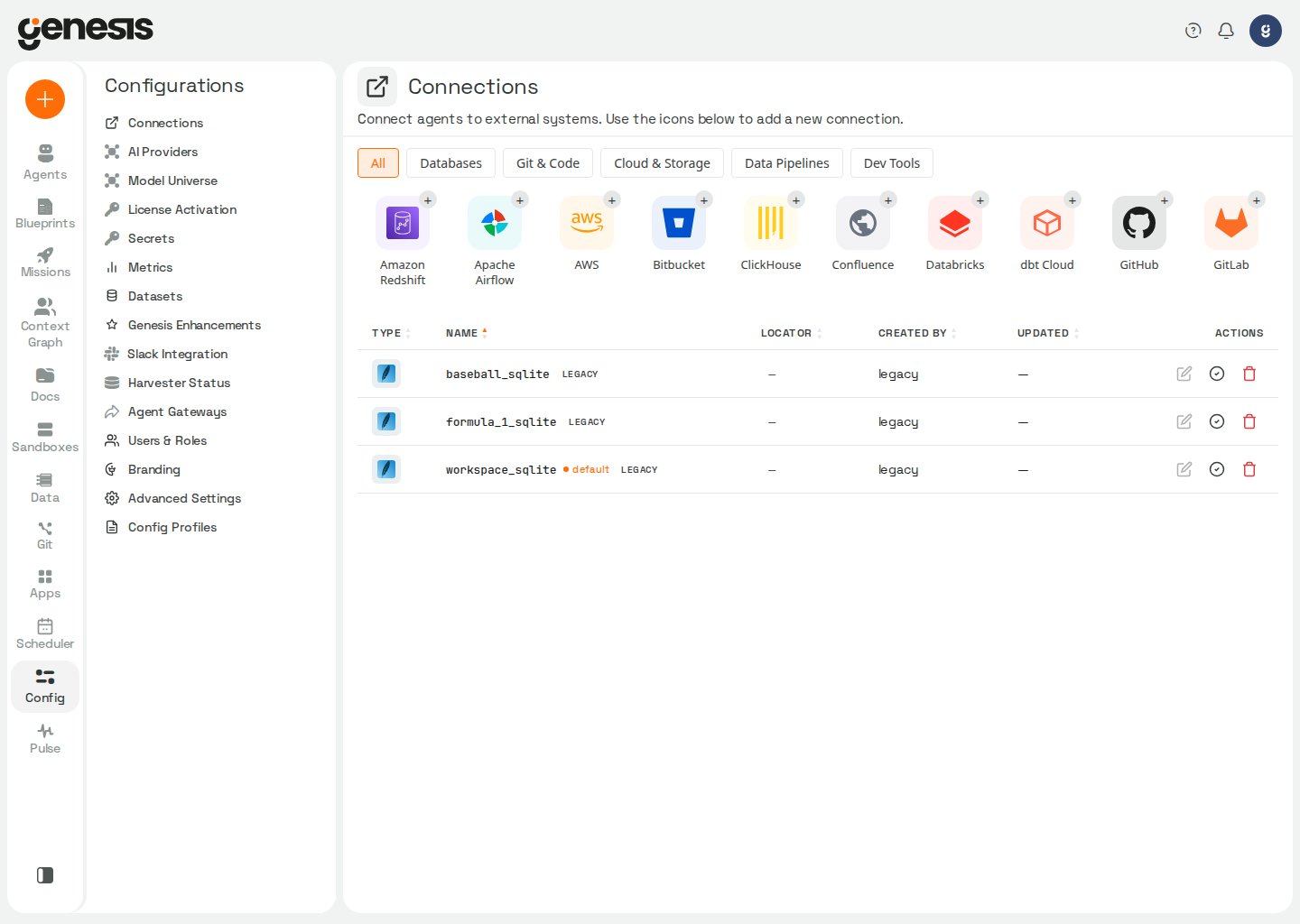 ## Main connection workflow
1. Open **Config -> Connections**.
2. Click **+ New Connection** in the page header (including the first-run empty state when you have no connections yet).
3. In the **New connection** modal, optionally filter by category or search, then select the provider you want.
4. Enter credentials or complete the relevant OAuth flow.
5. Choose **Connection scope** and default options (see [Personal vs shared connections](#personal-vs-shared-connections) and [Default connection layers](#default-connection-layers)).
6. Test the connection (for **User OAuth**, testing happens after you authorize — see below).
7. Save it for reuse.
The Google Chat **Connect** link on **Config → Request sources** opens a new
Google Workspace connection and requests `service_account` auth and `shared`
scope. The form selects that auth method when available and ignores the request
if it is marked unavailable. The effective scope still follows the current
user's permissions: users without `manage_all_connections` create personal
connections.
If the system is inside a private network that Genesis cannot reach (for example, Genesis
runs in Snowflake and the database is on-prem), answer **How does Genesis reach this
system?** with **Through a Genesis Outpost**. See [Genesis Outposts](/docs/Setup/Outposts-Overview).
When you edit a saved connection and change its connection details, Genesis tests
the new details before saving them. The update is refused if the target system
cannot be reached, and the existing connection and stored credentials remain in
place. If you choose **Use existing** for a credential conflict, Genesis tests the
credential that is already stored rather than the value entered in the form.
If a save needs to create or replace more than one stored credential and one write
fails, Genesis attempts to undo the other writes from that save so the connection
is not partially updated. Earlier replaced credentials are restored and newly
created credentials are deleted when possible. If another request changed a
credential after this save wrote it, Genesis leaves that newer value in place and
reports that the undo was incomplete; the connection is not saved.
When **Test Connection** fails, Genesis uses the HTTP status held by the
connection tester when one is available. A held `401` means the presented
credential was rejected, so Genesis appends when the connection's stored
credential was last written, when that timestamp is available. If the response
says that the credential is missing or unconfigured, Genesis does not treat the
`401` as a rejection of a stored credential. A held `403`
means access was refused without treating the stored credential as invalid, so
Genesis does not date it. Other held statuses are not interpreted as `401` or
`403` based on text from the response, although credential-specific wording can
still identify cases such as a revoked OAuth grant. If no status was returned,
Genesis falls back to the error text.
External secret references such as `outpost_
## Main connection workflow
1. Open **Config -> Connections**.
2. Click **+ New Connection** in the page header (including the first-run empty state when you have no connections yet).
3. In the **New connection** modal, optionally filter by category or search, then select the provider you want.
4. Enter credentials or complete the relevant OAuth flow.
5. Choose **Connection scope** and default options (see [Personal vs shared connections](#personal-vs-shared-connections) and [Default connection layers](#default-connection-layers)).
6. Test the connection (for **User OAuth**, testing happens after you authorize — see below).
7. Save it for reuse.
The Google Chat **Connect** link on **Config → Request sources** opens a new
Google Workspace connection and requests `service_account` auth and `shared`
scope. The form selects that auth method when available and ignores the request
if it is marked unavailable. The effective scope still follows the current
user's permissions: users without `manage_all_connections` create personal
connections.
If the system is inside a private network that Genesis cannot reach (for example, Genesis
runs in Snowflake and the database is on-prem), answer **How does Genesis reach this
system?** with **Through a Genesis Outpost**. See [Genesis Outposts](/docs/Setup/Outposts-Overview).
When you edit a saved connection and change its connection details, Genesis tests
the new details before saving them. The update is refused if the target system
cannot be reached, and the existing connection and stored credentials remain in
place. If you choose **Use existing** for a credential conflict, Genesis tests the
credential that is already stored rather than the value entered in the form.
If a save needs to create or replace more than one stored credential and one write
fails, Genesis attempts to undo the other writes from that save so the connection
is not partially updated. Earlier replaced credentials are restored and newly
created credentials are deleted when possible. If another request changed a
credential after this save wrote it, Genesis leaves that newer value in place and
reports that the undo was incomplete; the connection is not saved.
When **Test Connection** fails, Genesis uses the HTTP status held by the
connection tester when one is available. A held `401` means the presented
credential was rejected, so Genesis appends when the connection's stored
credential was last written, when that timestamp is available. If the response
says that the credential is missing or unconfigured, Genesis does not treat the
`401` as a rejection of a stored credential. A held `403`
means access was refused without treating the stored credential as invalid, so
Genesis does not date it. Other held statuses are not interpreted as `401` or
`403` based on text from the response, although credential-specific wording can
still identify cases such as a revoked OAuth grant. If no status was returned,
Genesis falls back to the error text.
External secret references such as `outpost_